The noise reduction coefficient (NRC) is a single number from 0 to about 1 that shows how much sound a material absorbs. It averages the absorption a laboratory measures across four speech frequencies. An NRC of 0.70 means the surface soaks up roughly 70 per cent of incoming sound.
Most acoustic products are sold with an NRC, and two quotations for the same wall can show very different figures. The number is useful, but only if you know where it comes from and what it leaves out. An NRC measured on a panel standing off the wall cannot be compared with one fixed flat, and a single figure cannot tell you how a product handles bass. Reading it properly avoids paying for absorption a room will never get.
NRC in five points
- Scale: 0 reflects all sound; values around 1 absorb almost all of it.
- Frequencies: an average of four bands, 250 to 2000 Hz, where speech carries most of its energy.
- Test: measured in a reverberation room under ASTM C423.
- Mounting: the same product scores differently fixed flat and on an air gap.
- Limits: NRC says little about bass, and nothing about keeping sound out of a room.
What does NRC mean?
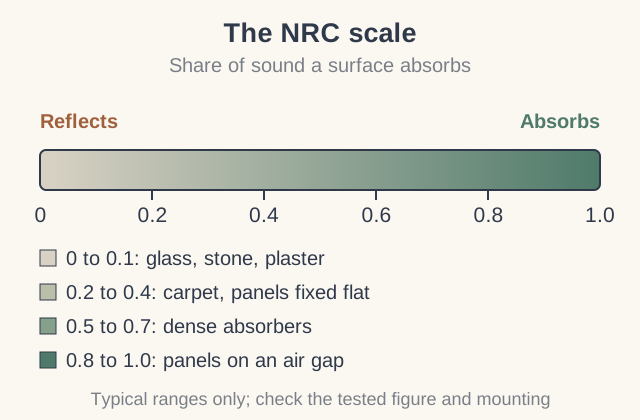
The term describes how much sound energy a surface absorbs instead of reflecting back into the room. A coefficient of 0 means a perfect reflector, like polished stone or glass; a coefficient near 1 means almost everything that strikes the surface is absorbed. The higher the NRC, the more a material helps to cut echo and reverberation, which is why it is the first figure people compare when choosing acoustic panels.
How is NRC calculated?
A sample of the material is placed in a reverberation room, a hard, echoing test chamber, and the laboratory measures how much faster sound dies away with the sample present than without it. That gives an absorption coefficient at each frequency. The NRC is the average of the coefficients at 250, 500, 1000 and 2000 Hz, rounded to the nearest multiple of 0.05, as Intertek's summary of ASTM C423 sets out. Because of how the test works, coefficients for very absorbent materials can come out slightly above 1, which is a feature of the method rather than a material absorbing more than all the sound.
What is a good NRC rating?
For a product bought to control echo, look for 0.70 or above where it will be mounted. A rough guide:
- Below 0.20: essentially reflective; hard finishes such as tile, stone, glass and plaster.
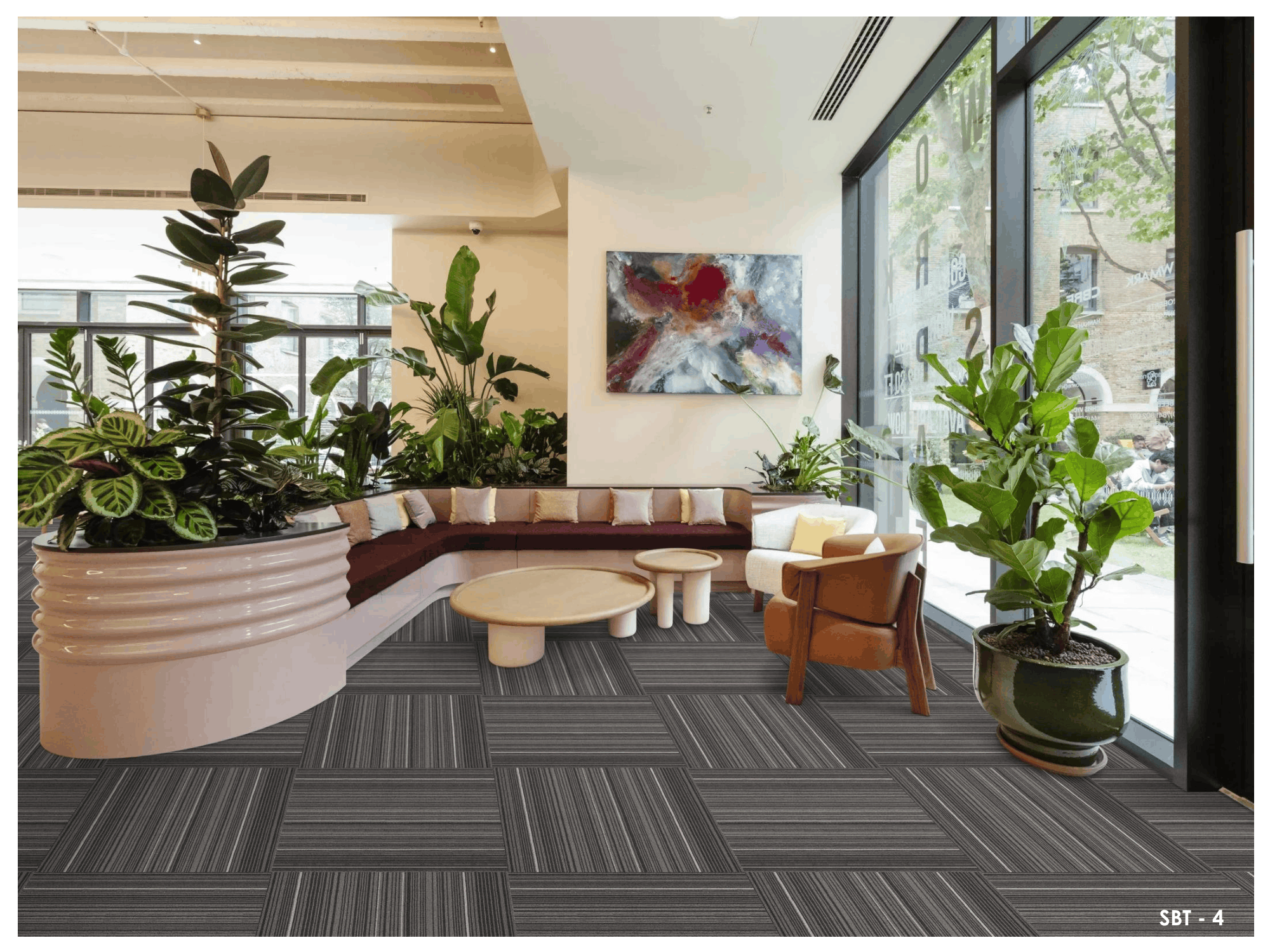
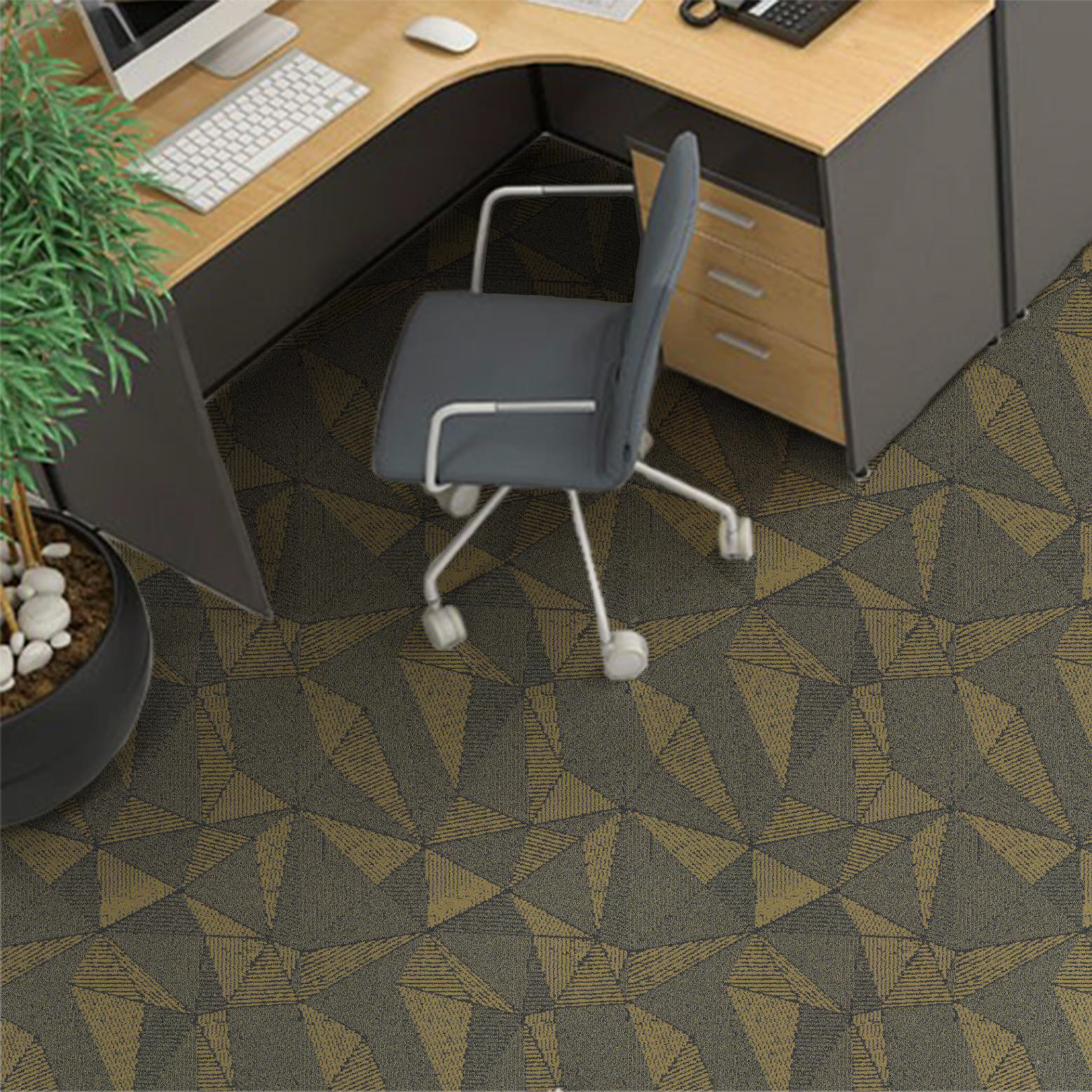
- 0.20 to 0.45: some absorption; carpet, thin boards and panels fixed directly to a wall.
- 0.50 to 0.75: good absorption for most rooms.
- 0.80 and above: high absorption, typical of acoustic panels on an air gap and thick, purpose-made absorbers.
A higher NRC is not automatically better for every wall. Enough absorption, spread around the room, matters more than one very absorbent patch; see where absorption should go.
Why does mounting change the NRC?
Because a porous absorber works best where air is moving, and air barely moves right against a hard wall. Stand the same panel off the wall and its fibres sit where the sound wave has more movement, so it absorbs more, especially at lower frequencies. Laboratories therefore test products in defined mountings, and an honest datasheet states which one was used. Compare figures only for the same mounting. Our article on the air gap behind acoustic panels gives the tested figures for GAIA PET panels fixed flat and on a gap.
NRC, SAA and αw: what is the difference?
They are three ways of turning the same test into a single number.
- NRC: the average of four octave bands from 250 to 2000 Hz, rounded to 0.05. The rating most acoustic suppliers in India quote, GAIA included.
- SAA (sound absorption average): the average of twelve one-third-octave bands from 200 to 2500 Hz, rounded to 0.01. A finer version of the same idea, also from ASTM C423.
- αw (weighted sound absorption coefficient): the European rating under ISO 11654, from tests to ISO 354. It also places products in classes A to E: class A covers αw 0.90 to 1.00, class B 0.80 to 0.85, class C 0.60 to 0.75, class D 0.30 to 0.55 and class E 0.15 to 0.25, as Arup's reference lists.
The three are close but not interchangeable, so compare like with like.
What does NRC not tell you?
Three things worth knowing before a purchase:
- Bass: the average starts at 250 Hz, so a product can score well while doing little about low-frequency boom in a home theatre or a large hall.
- Soundproofing: NRC measures absorption inside a room. Stopping sound passing through a wall or door is a separate property, measured with ratings such as STC or Rw.
- Room results: NRC describes a material, not a room. How much the room improves depends on how much surface you treat and where.

How do you compare acoustic products using NRC?
- Ask for the test report, not only a quoted figure, and check the standard named on it.
- Check the mounting used in the test, and compare products tested the same way.
- Compare at the thickness you will actually buy.
- Look at the full frequency table if bass matters, as it does in home theatres and halls.
- Remember that finish, durability and fire performance matter too; see how panels and foam compare.
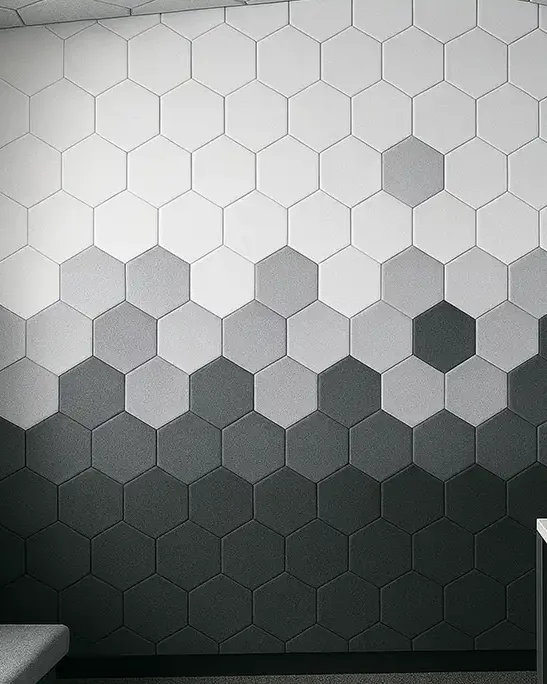
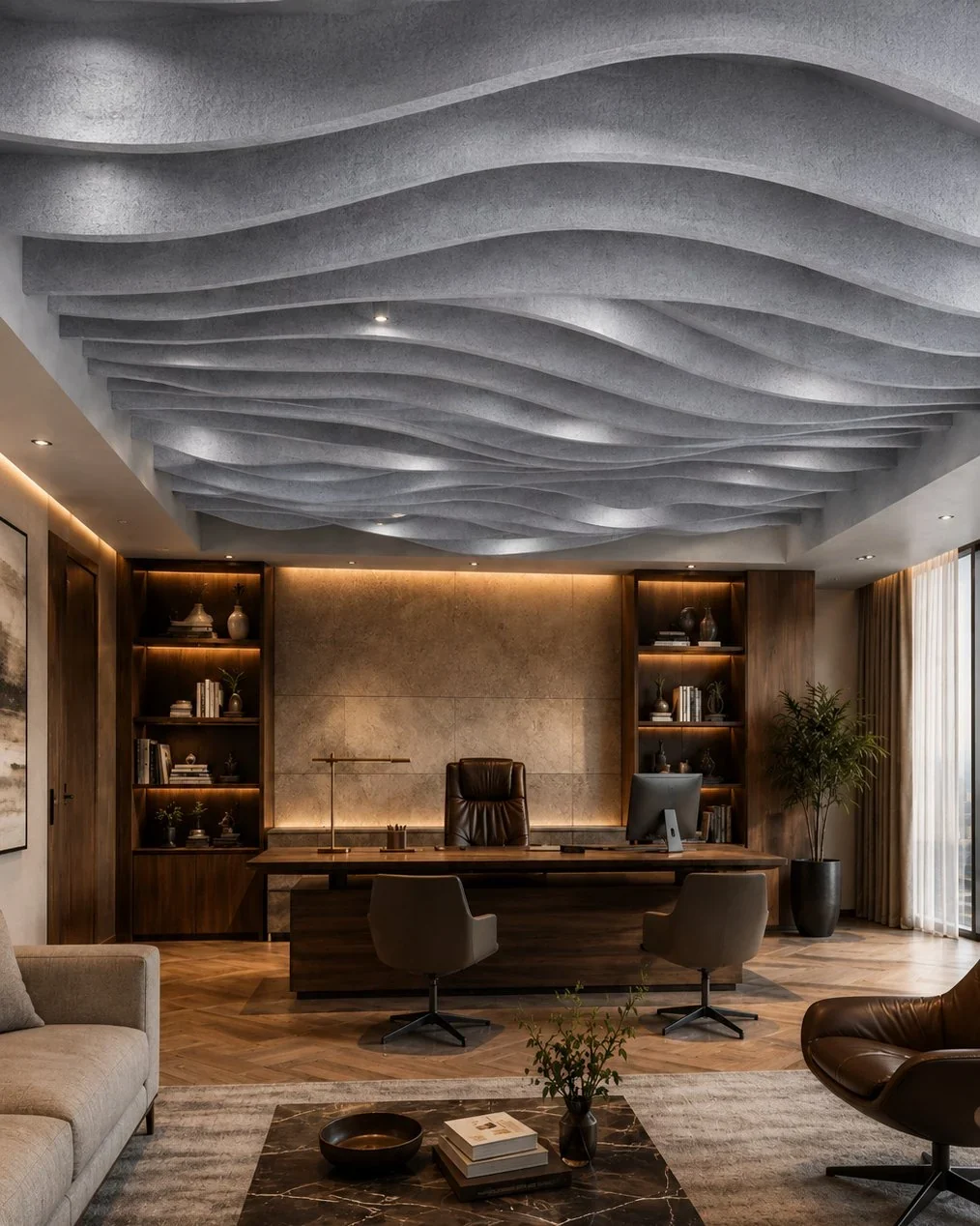
Wall panels, baffles and clouds are all part of the GAIA acoustic range.
What to send us
- the room's size and use;
- the NRC or test figures you have been quoted, if you are comparing products;
- whether panels can stand off the wall, or must be fixed flat;
- photographs of the walls and ceiling.
Our team will recommend panel type, thickness and mounting for the absorption your room needs.
NRC questions
Is a higher NRC always better?
For absorbing echo, generally yes, but placement and coverage matter as much. A room can also be over-treated, which leaves it sounding dull and lifeless.
What is the NRC of carpet?
It varies with pile, backing and underlay. Carpet on a hard floor usually falls in the lower part of the scale, which is why it helps a room but rarely fixes an echo on its own.
Does NRC measure soundproofing?
No. NRC measures absorption within a room. Sound passing through walls and doors is rated separately, with measures such as STC or Rw.
Absorption you can rely on
Choose the right acoustic panels for your room
Tell GAIA by Sanson Floorings about your room and the figures you are comparing, and we will recommend panels and mounting that deliver the absorption you need.