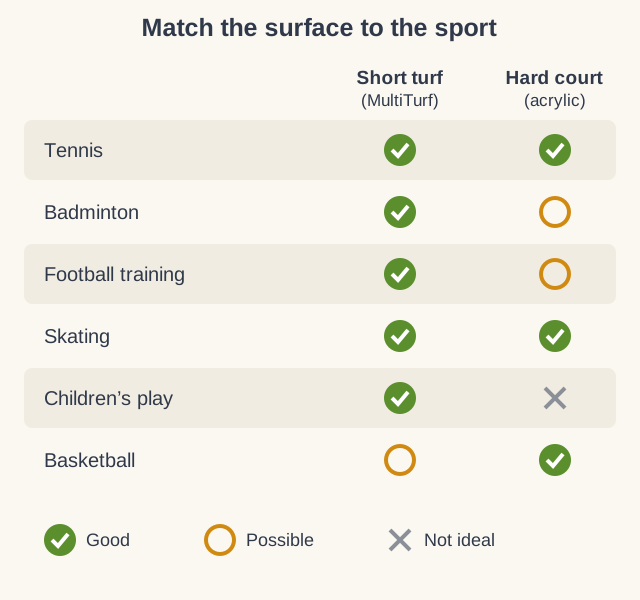
Multi-sport court flooring must play fairly for every game marked on it. For tennis, badminton, skating and casual ball games, a short, dense turf such as MultiTurf from GAIA by Sanson Floorings, at 10 or 15 mm, gives an even surface with good grip. Basketball suits a hard court.
Housing societies, schools, clubs and rooftop developers rarely have room for a separate court for every sport. One well-planned surface can host tennis in the morning, children's games in the afternoon and badminton in the evening. The difficulty is that each sport asks something slightly different of the floor: a predictable bounce, firm footing for quick turns, a smooth roll for wheels, or forgiveness when someone falls. The right choice starts with an honest answer to one question: which sport will be played most?
Multi-sport courts at a glance
- Pick the main sport first: it sets the surface, the size and the line plan.
- Short turf for mixed play: even, grippy and forgiving for most court games.
- Hard courts for basketball: a dribbled ball needs a hard, uniform bounce.
- Base before surface: a level, well-drained concrete or asphalt slab.
- Lines with a system: one colour per sport, the main sport in white.
What is the best surface for a multi-sport court?
The one that best serves the sport played most, while still being fair to the others. Sport England's guidance on artificial surfaces for outdoor sport groups the options into artificial grass, needle-punch and polymeric surfaces, and judges each by the sports and level of play it suits. For most residential and school courts, the choice comes down to two families: a short artificial turf, which is comfortable, quiet and forgiving underfoot, or a hard acrylic or polymeric court, which gives a faster, harder bounce.
Which sports can be played on MultiTurf?
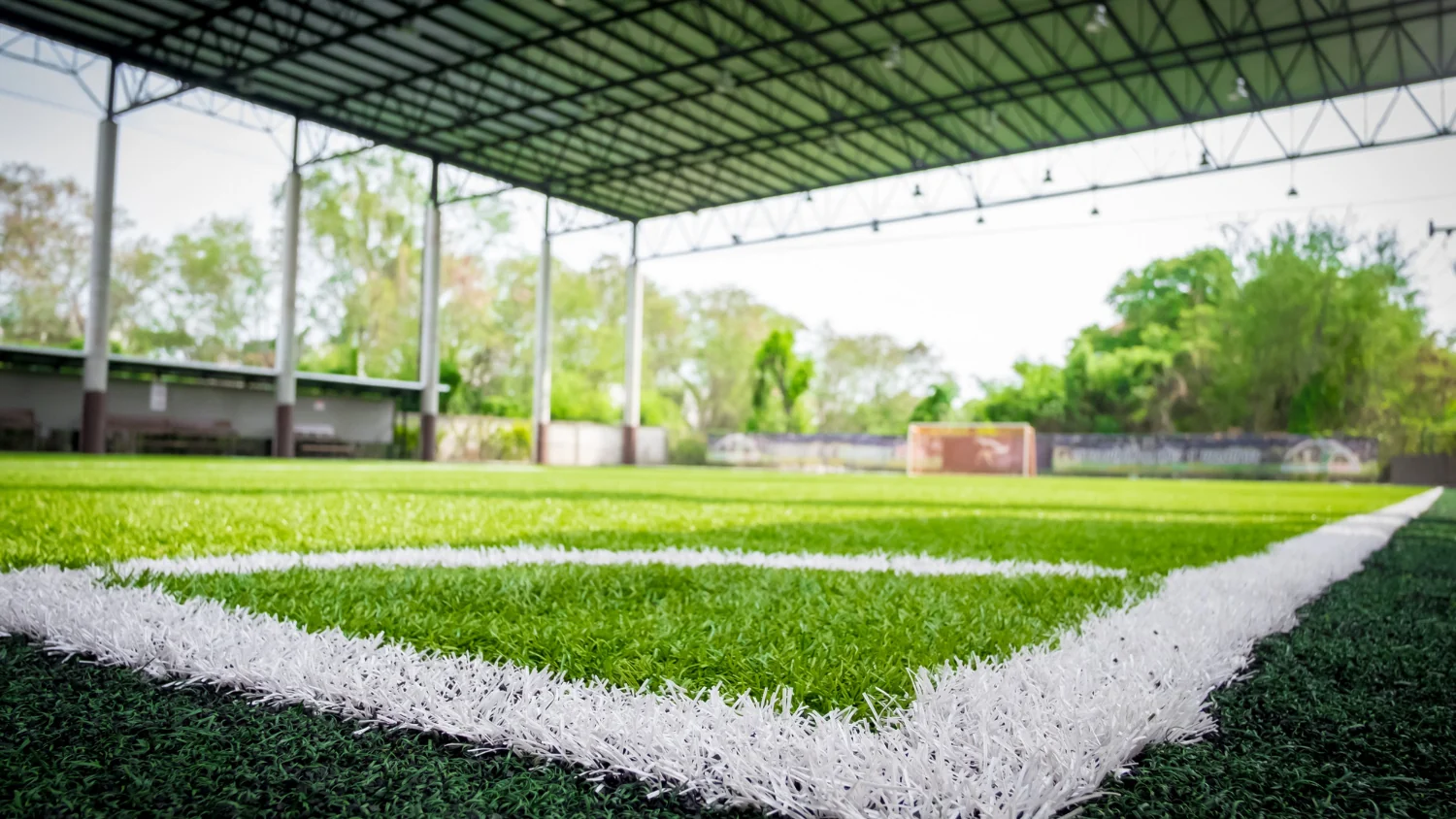
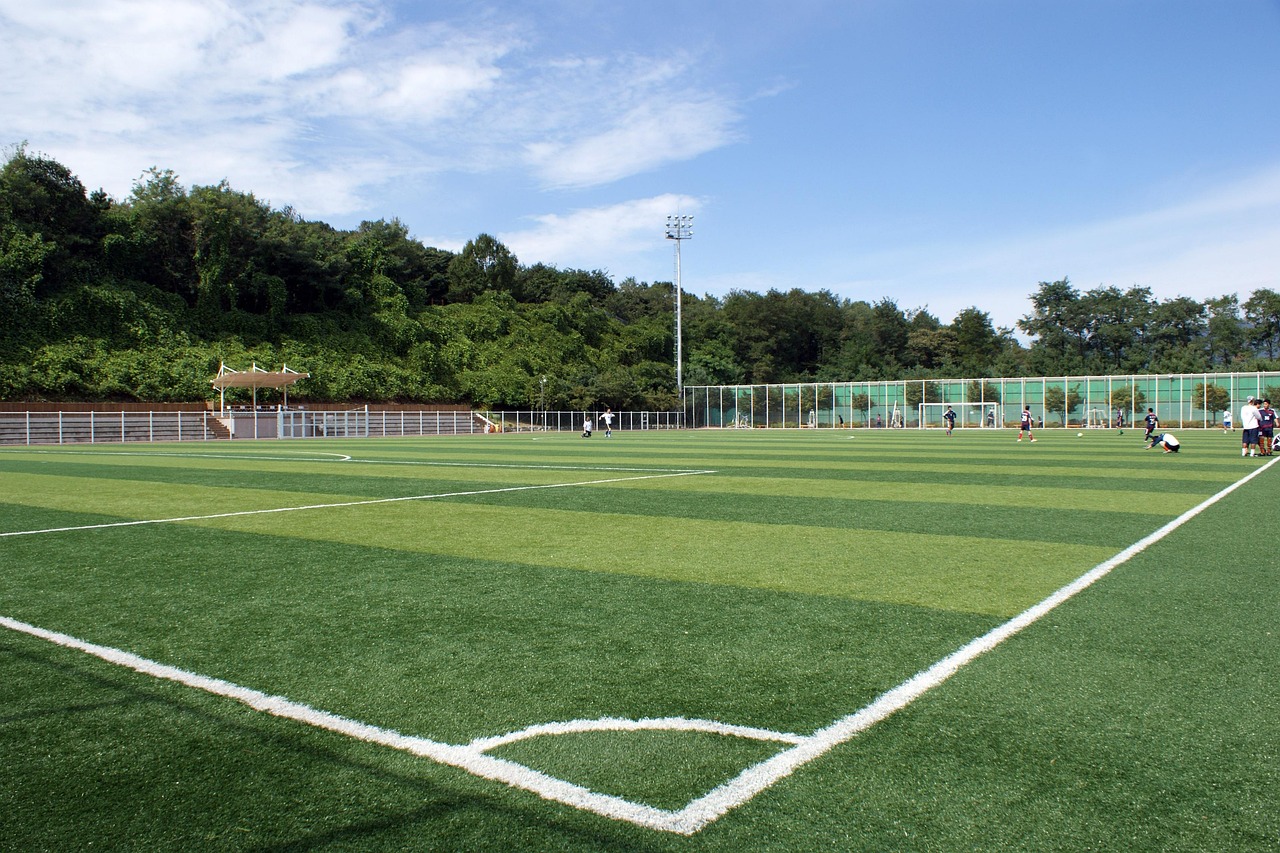
Court games and active play that need an even, firm surface. There are two GAIA MultiTurf heights, 10 mm and 15 mm, both made for tennis and badminton courts, gym floors and areas for skating, and the turf works well for football training and children's play areas. Its short pile keeps the ball and shuttle behaving predictably, while giving more grip and comfort than a painted slab. The range is at GAIA MultiTurf.
Basketball is the exception. A basketball needs a hard, uniform surface to bounce off, and even a short turf takes a little energy out of each dribble. Shooting practice on turf is fine; a court used mainly for basketball games is better hard. For a football-first space, the longer turfs in turf for 5-a-side pitches suit better.
10 mm or 15 mm MultiTurf?
Both are short, firm surfaces. At 10 mm, the surface is at its tightest and quickest, with the least give underfoot, which suits racquet sports and wheels. The 15 mm pile feels a little softer and more grass-like, which suits courts shared with children's play, football training and general fitness. If the court will be used mostly by one group, choose for them; if it will be shared by everyone, the 15 mm pile is the more forgiving compromise.
How should lines be planned for several sports?
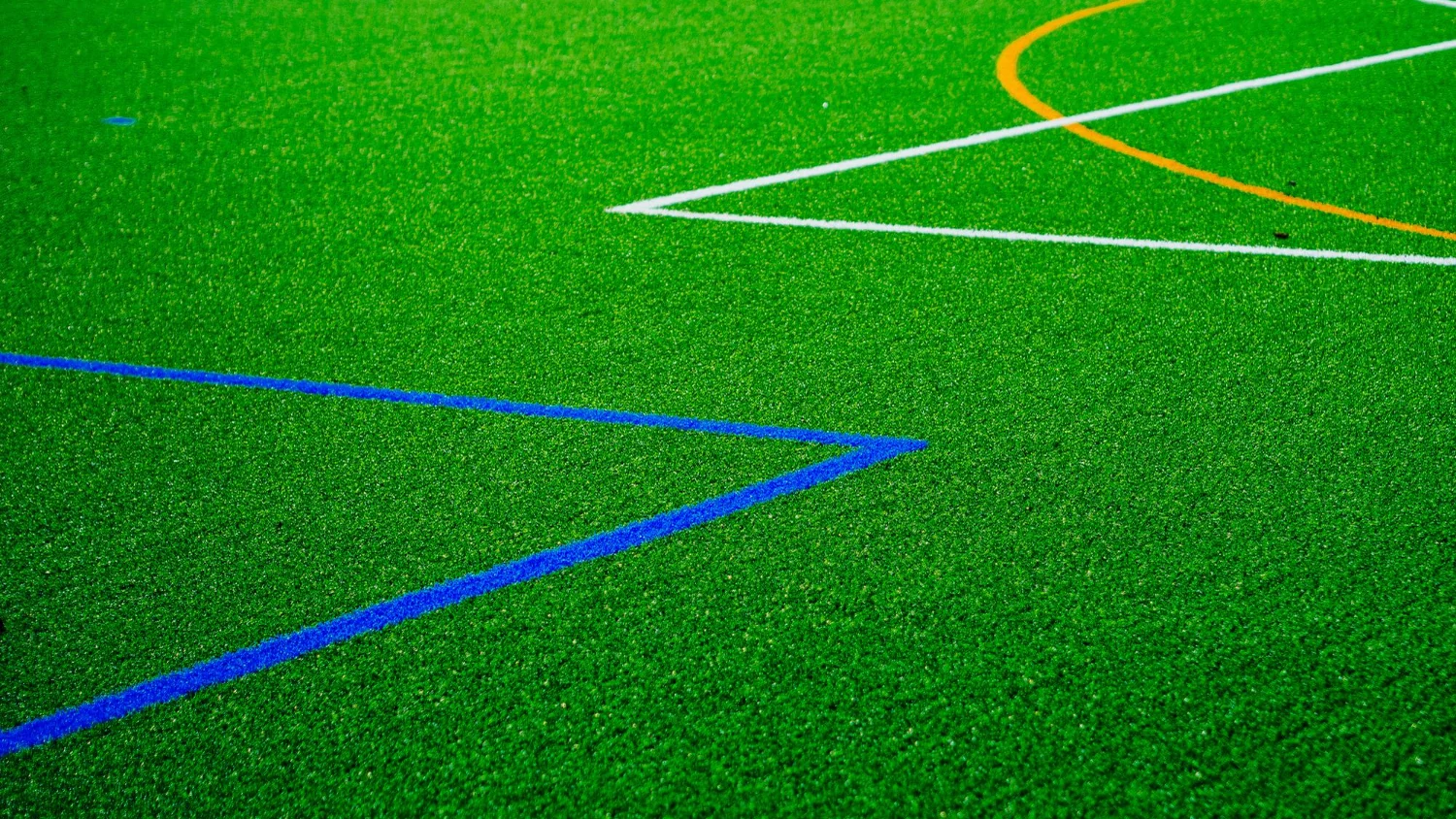
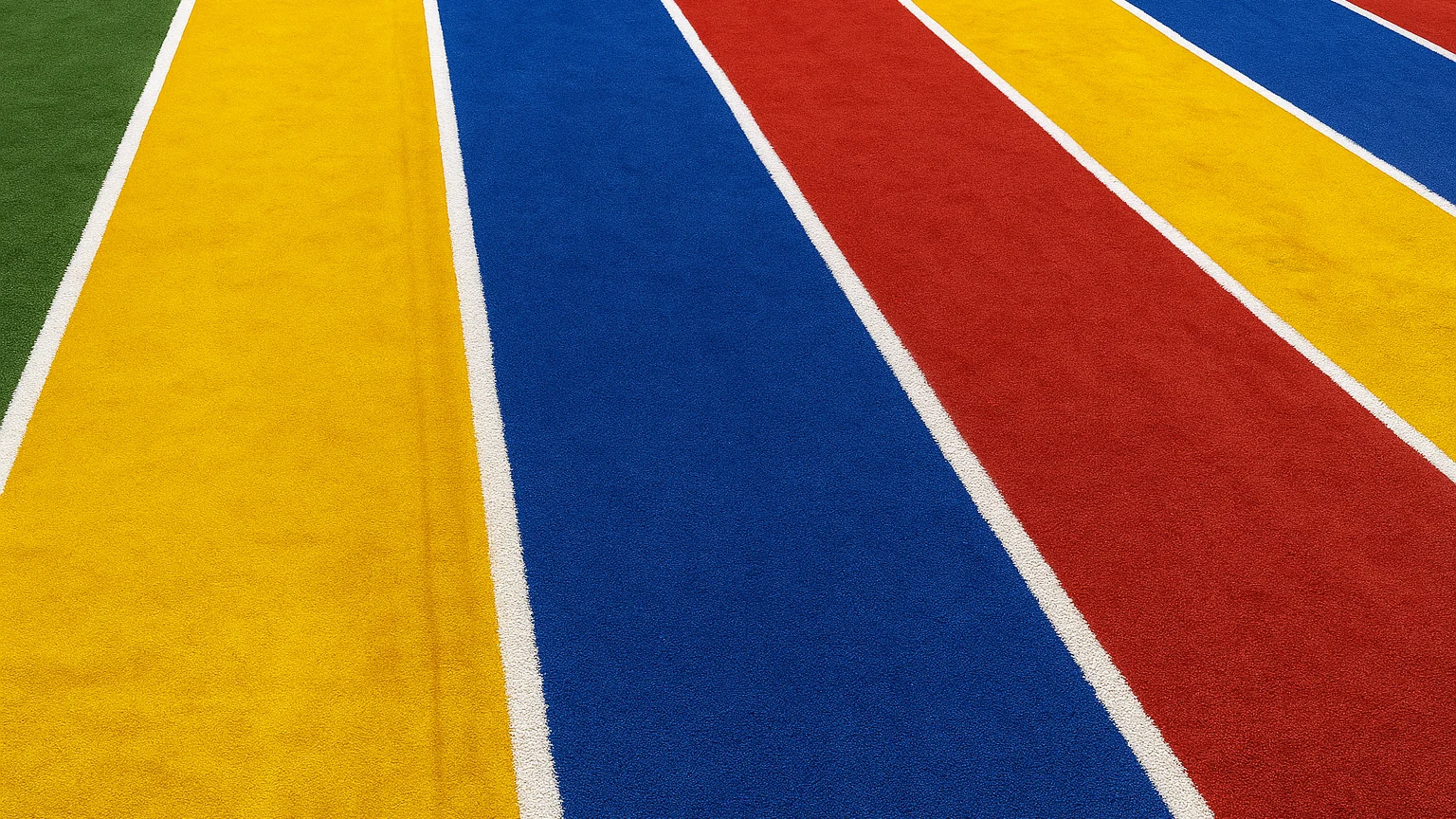
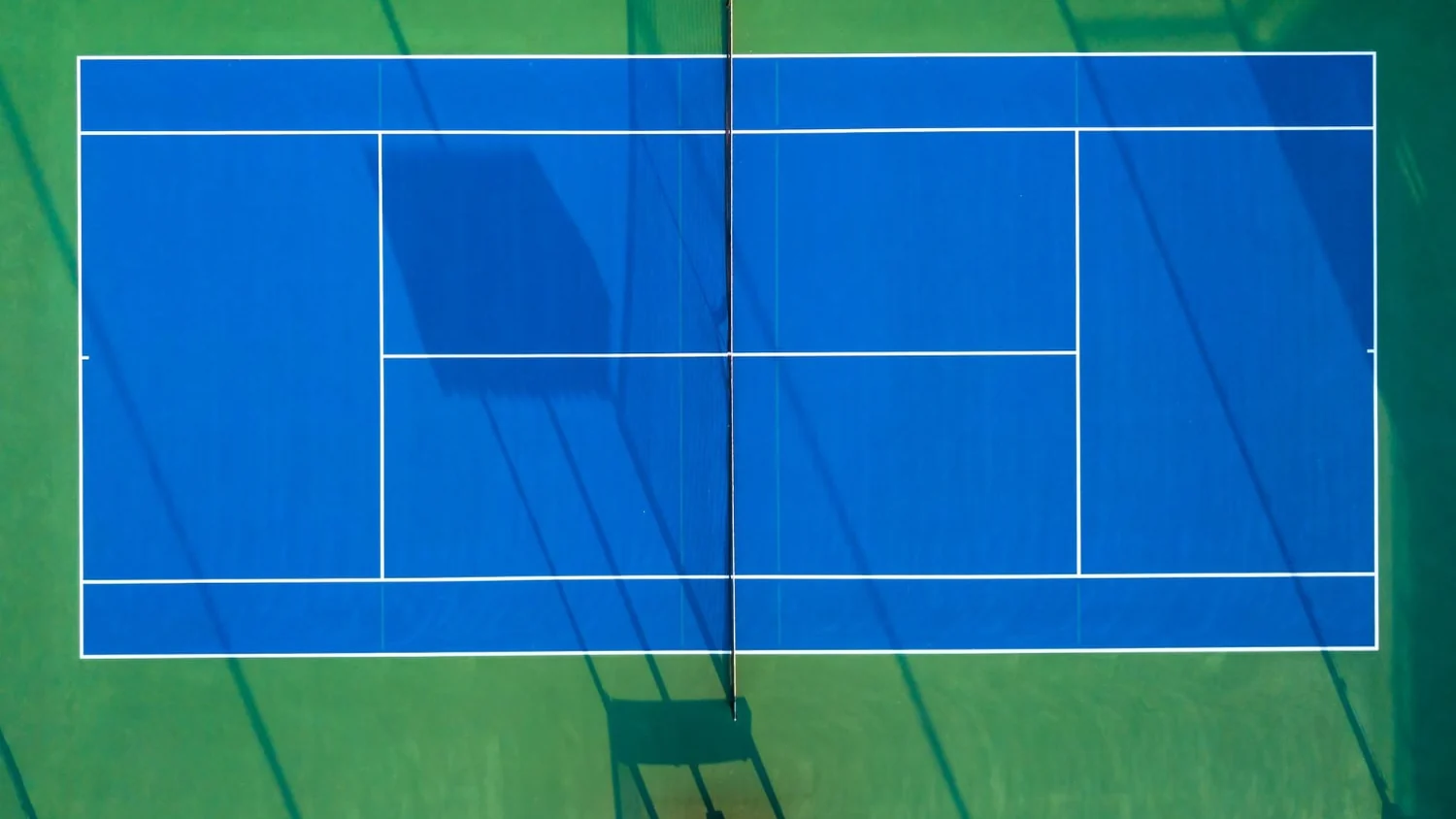
Start with the main sport's court and make its lines white, then add the others in distinct colours: yellow for badminton, blue or red for a children's game, for example. Keep the number of overlapping sports to two or three, or players stop being able to read the court. For reference, a doubles tennis court measures 23.77 × 10.97 m and a badminton court 13.40 × 6.10 m, so a full-size tennis enclosure usually has room for badminton courts marked within it. On turf, lines are inlaid during installation in a contrasting colour, so they last as long as the surface.
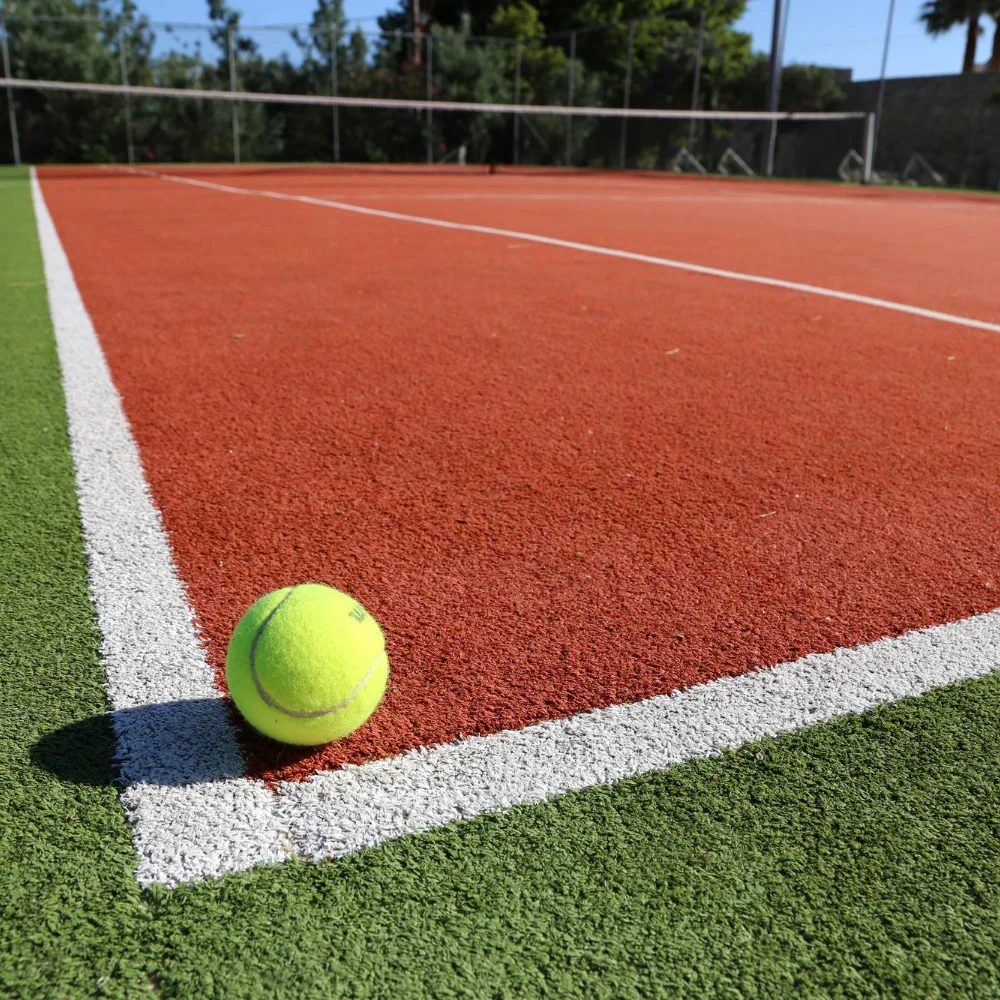
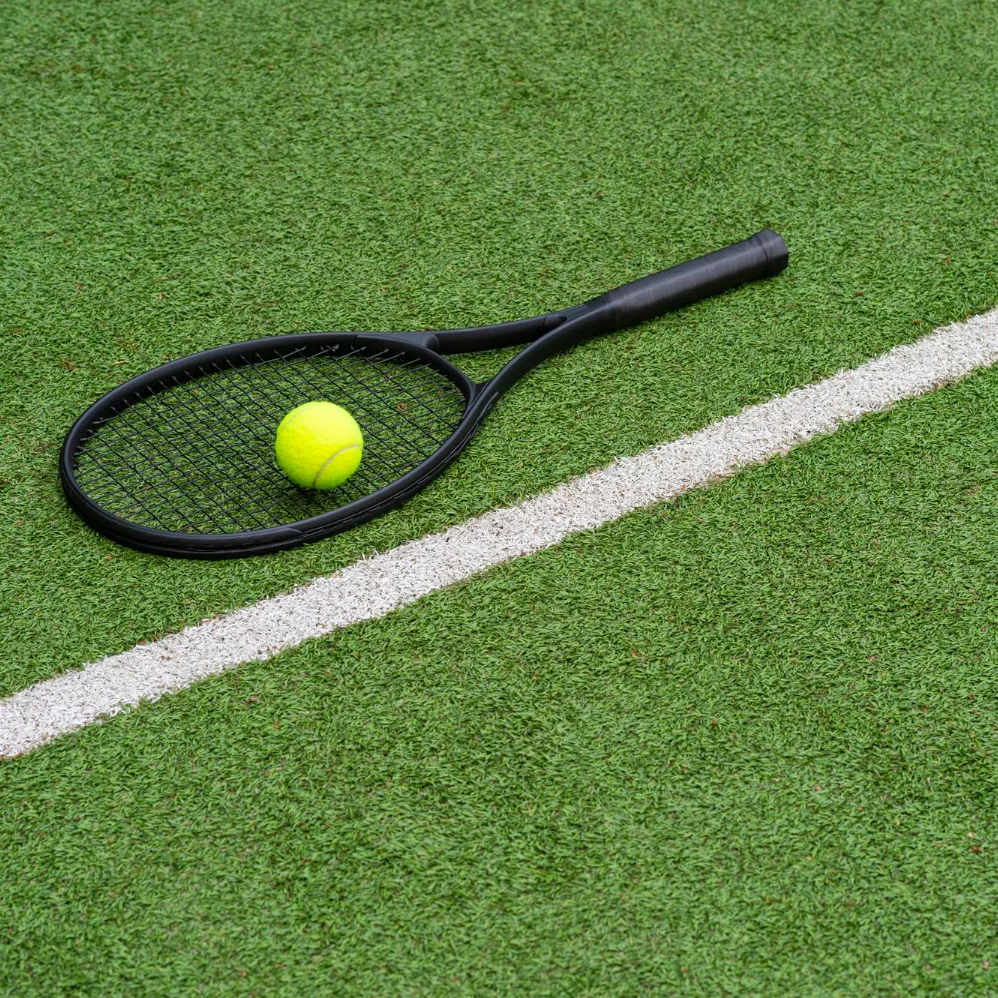
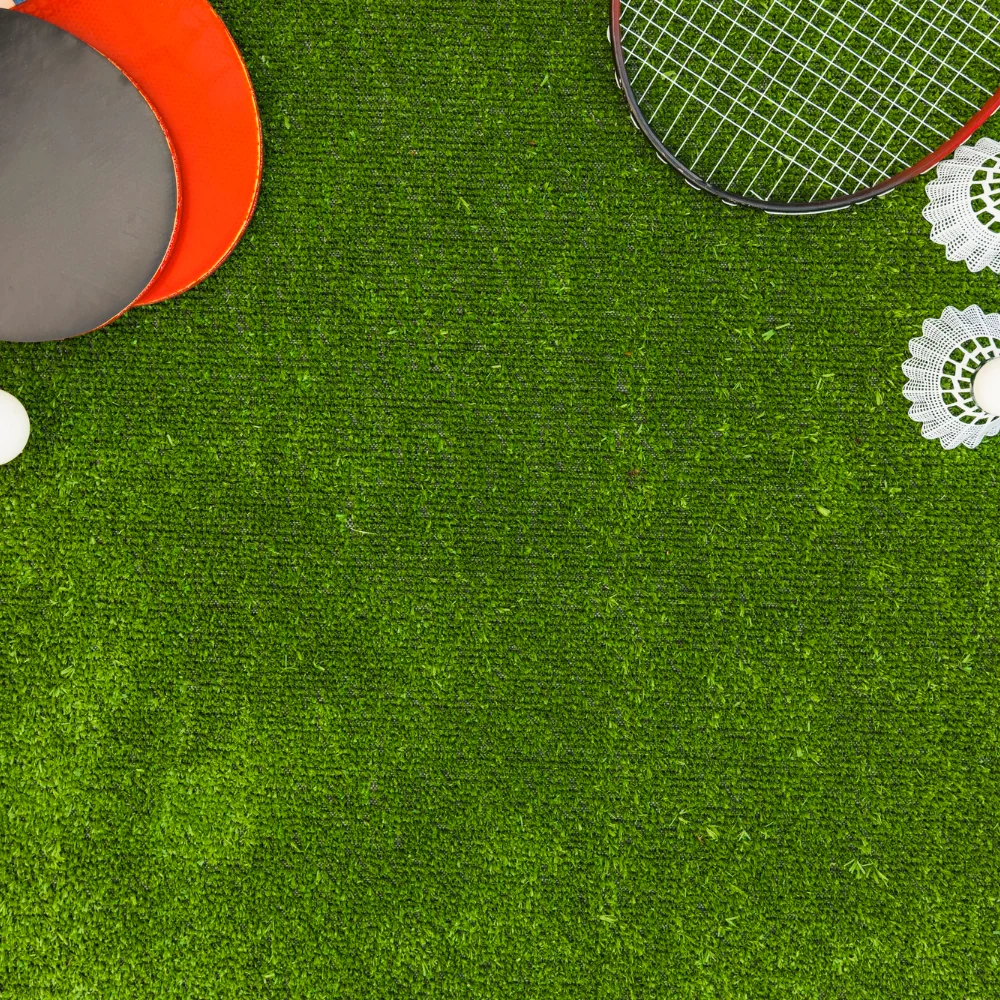
Tennis, badminton and ball games on short, dense court turf with inlaid lines.
What base does a turf court need?
A sound, level concrete or asphalt slab with a gentle fall for drainage. Turf follows every bump in the base, so any ridges, cracks or ponding need correcting first. The slab is cleaned and primed, the turf is laid and joined, and the lines are cut in. On rooftops, check the slab's waterproofing and drainage before any surface goes down. Outdoor courts also need fencing or netting, and floodlighting if they will be used after dark.
Can a multi-sport court go on a rooftop?
Yes, and in dense Indian cities the roof is often the only space a building has for one. A rooftop court needs three checks before any surface is ordered: a structural engineer's confirmation that the slab can carry the surface, the people and any fencing posts; waterproofing that is sound and protected; and clear paths for water to reach the roof drains. Fencing or netting on every side keeps balls on the court, and shade over spectator areas makes the court usable on summer evenings. The same principles appear in laying turf on a terrace. Short court turf generally needs much less infill than long football turf, which keeps the load on the slab lower, as explained in our pile height comparison.
What upkeep does a multi-sport court need?
- Sweep or blow off leaves and grit weekly.
- Brush turf against the grain so the pile stays upright.
- Keep drains and edges clear so water never sits on the court.
- Check joints and line edges and repair lifting edges at once.
- Keep bicycles, chairs and heavy equipment off unless the surface is protected.
For routine cleaning of turf surfaces, see cleaning artificial grass. The Synthetic Turf Council's guidelines make the same point for every synthetic surface: regular brushing and debris removal keep it playing as designed.
What to send us
- the court or plot dimensions;
- the sports you want to play, in order of priority;
- the existing base: concrete, asphalt, soil or roof slab;
- photographs of the site.
Our team will suggest the MultiTurf pile height and a line plan for your sports.
Multi-sport court questions
Can badminton be played on artificial turf?
Yes. A short, dense turf gives good footing for badminton. Outdoors, wind affects the shuttle more than the surface does, so sheltered courts play best.
Is artificial turf good for a tennis court?
Yes, a short turf gives a comfortable, consistent surface for recreational tennis, with a slightly slower bounce than a hard court.
Can skating be done on MultiTurf?
Yes. GAIA MultiTurf is made for skating areas as well as tennis and badminton courts, because its short, dense pile gives wheels a smooth, even roll.
How long does a turf court take to install?
On a sound, level slab, a typical society court can be laid and lined in a few days. Repairs to the base, drainage or waterproofing add time before laying starts.
One court, every game
Plan your multi-sport court
Tell GAIA by Sanson Floorings which sports you want to play and the size of your space, and we will recommend the surface and line plan.