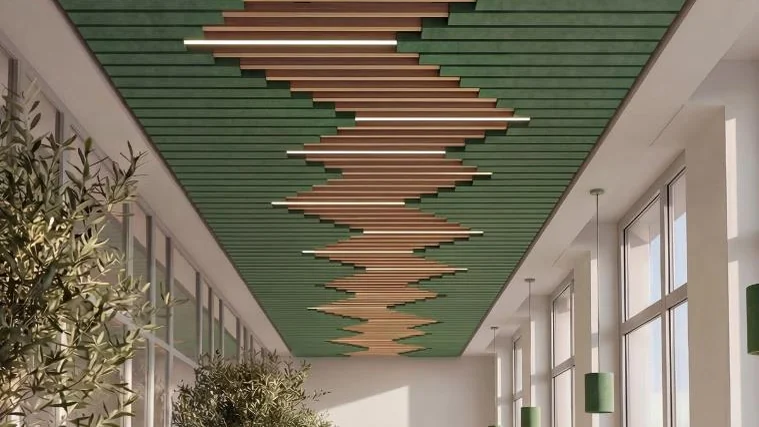
Acoustic baffles hang vertically and suit tall, open spaces where the ceiling is high or full of services. Ceiling clouds hang horizontally and suit lower rooms, sitting over the people speaking. GAIA by Sanson Floorings makes both from PET acoustic material, with integrated suspension fittings.
Many new Indian offices, cafés, schools and malls leave the slab exposed: ducts, cable trays and sprinkler lines in full view, with a high, hard concrete soffit above. It looks good and saves on false ceilings, but it is loud. Sound bounces between the bare slab and the hard floor, and conversation turns into a roar. Suspended acoustic elements are the usual answer, and the choice comes down to baffles or clouds. This article explains how each one works, where each one fits, and how to decide.
Baffles vs clouds at a glance
- Baffles: vertical blades hung in rows, absorbing sound on both faces.
- Clouds: horizontal panels hung below the ceiling, absorbing on both faces and the edges.
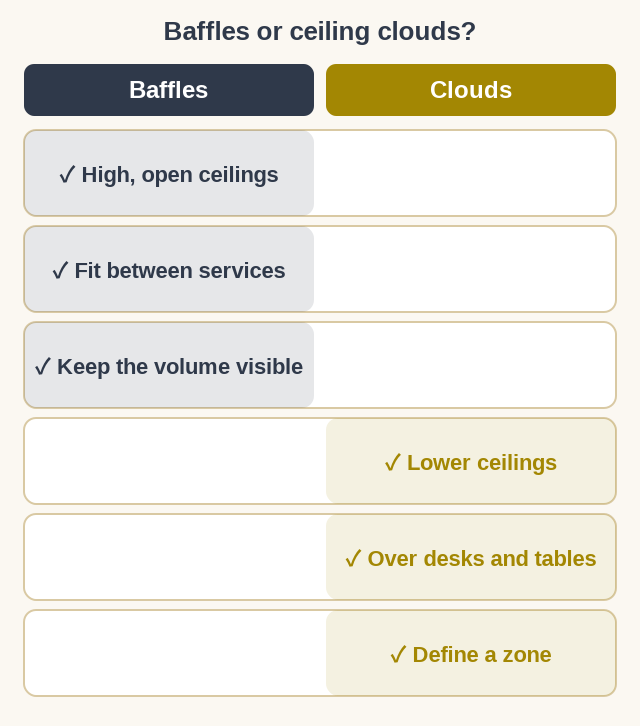
- High, open ceilings: baffles fit between services and keep the volume visible.
- Lower rooms and focused zones: clouds sit over desks, tables and meeting areas.
- Both: often used together, with wall panels where people talk.
What is the difference between acoustic baffles and clouds?
Their orientation, and what that does to the space. A baffle is a panel hung on its edge, like a blade, usually in rows across a room. Because it is vertical, both of its large faces are exposed to sound, and it takes up little plan area, so it slots between lights, ducts and sprinklers. A cloud is a panel hung flat, parallel to the floor, at a set distance below the soffit. The air space above it lets sound reach its back face too, so a cloud absorbs on both sides, much as a wall panel does when mounted with an air gap. Clouds read as a ceiling plane over a defined area; baffles read as a rhythm of lines across the whole room.
Which is better for a high, exposed ceiling?
Baffles, in most cases. In a tall space, a cloud hung close to the slab is a long way from the people speaking, and one hung low needs long suspension rods. Baffles can hang at a height that clears the services, in rows that follow the grid of the building, and their vertical faces catch sound travelling across the room as well as up to the ceiling. They also keep the sense of height that the exposed-ceiling design was meant to create. Halls, atriums, canteens, gyms and large open offices often use baffles for that reason; see how to reduce echo in a hall.
When are ceiling clouds the better choice?
Where the ceiling is lower, where sound needs controlling over a particular zone, or where the design calls for a floating plane. Clouds work well over meeting tables, collaboration areas, reception desks, classroom teaching zones and restaurant dining areas, putting the absorption directly above the people talking. They can be cut to shapes and sizes that echo the furniture below or the brand's identity. In a lower room, a few large clouds can do the work of many rows of baffles. Speech in offices is covered in office acoustics.
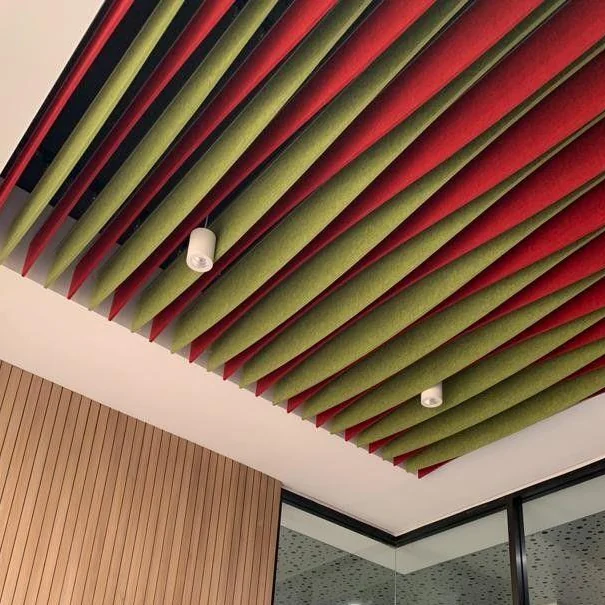
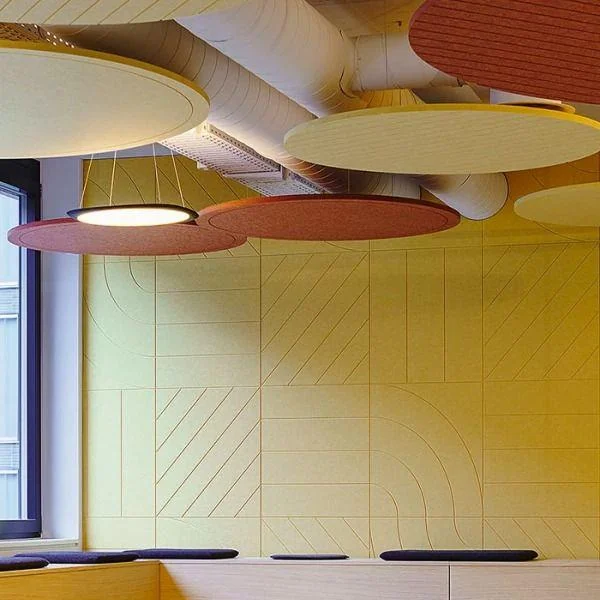

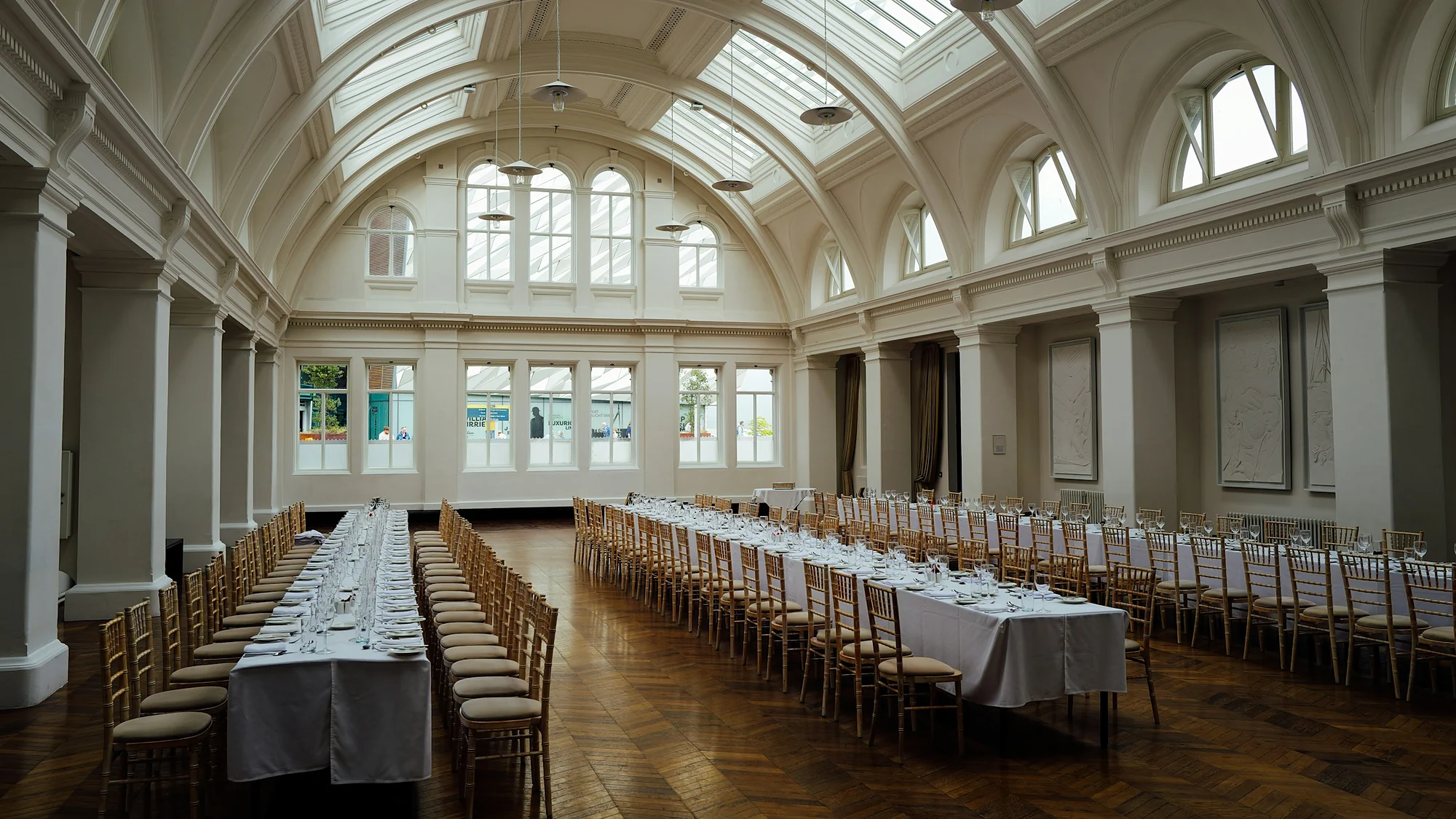
Linear baffles, round ceiling clouds and an open cell ceiling: three ways to treat an exposed soffit.
What do GAIA baffles and clouds look like?
GAIA ceiling baffles come in Linear and Wave styles: straight blades in parallel rows, or blades with a flowing profile that creates a rippling ceiling. GAIA ceiling clouds are suspended panels available in a variety of shapes and custom sizes. Both are made from GAIA's PET acoustic material, made from recycled polyester fibres bonded with heat, and both come with integrated suspension fittings, so they can be installed vertically or horizontally. Where a project needs an open grid across the whole ceiling, the GAIA open cell ceiling offers various cell sizes, colours and custom layouts. The range is shown under GAIA acoustic PET panels.
How much absorption does a suspended element give?
It depends on its size, its spacing and how it is hung, which is why suspended products are tested in their mounting. ASTM E795 sets out how specimens are mounted in the laboratory for sound absorption tests under ASTM C423, so that tests simulate normal use. For a design, the practical rules are simple: more surface area in the room means more absorption, elements close to the people speaking do more, and spacing rows too far apart leaves sound free to travel along the gaps. Air space behind a panel also matters, as acoustic panels and the air gap explains.
Baffles or clouds checklist
- Measure the clear height and map the services on the soffit.
- Mark where people talk: desks, tables, counters and stages.
- Choose baffles for high, open volumes and clouds for lower, focused zones.
- Agree colours and shapes with the interior scheme.
- Add wall panels where speech carries at head height.
What to send us
- the reflected ceiling plan or photographs of the soffit;
- the floor-to-slab height and the services in the way;
- how the space is used and where it feels loudest;
- the look you want: rows, waves, shapes or a grid.
Our team will propose a baffle or cloud layout for your ceiling.
Baffles and clouds questions
Can baffles and clouds be used together?
Yes. Many spaces use baffles over circulation and open areas and clouds over meeting or dining zones, with wall panels where people talk.
Do acoustic baffles work in low ceilings?
They can, but they take headroom. In lower rooms, clouds or panels fixed to the ceiling are usually a better fit.
Can acoustic clouds be custom shapes?
Yes. GAIA ceiling clouds are available in a variety of shapes and custom sizes.
Quiet above an open ceiling
Plan baffles or clouds
Send GAIA by Sanson Floorings your ceiling plan and photographs, and we will propose acoustic baffles or clouds for the space.