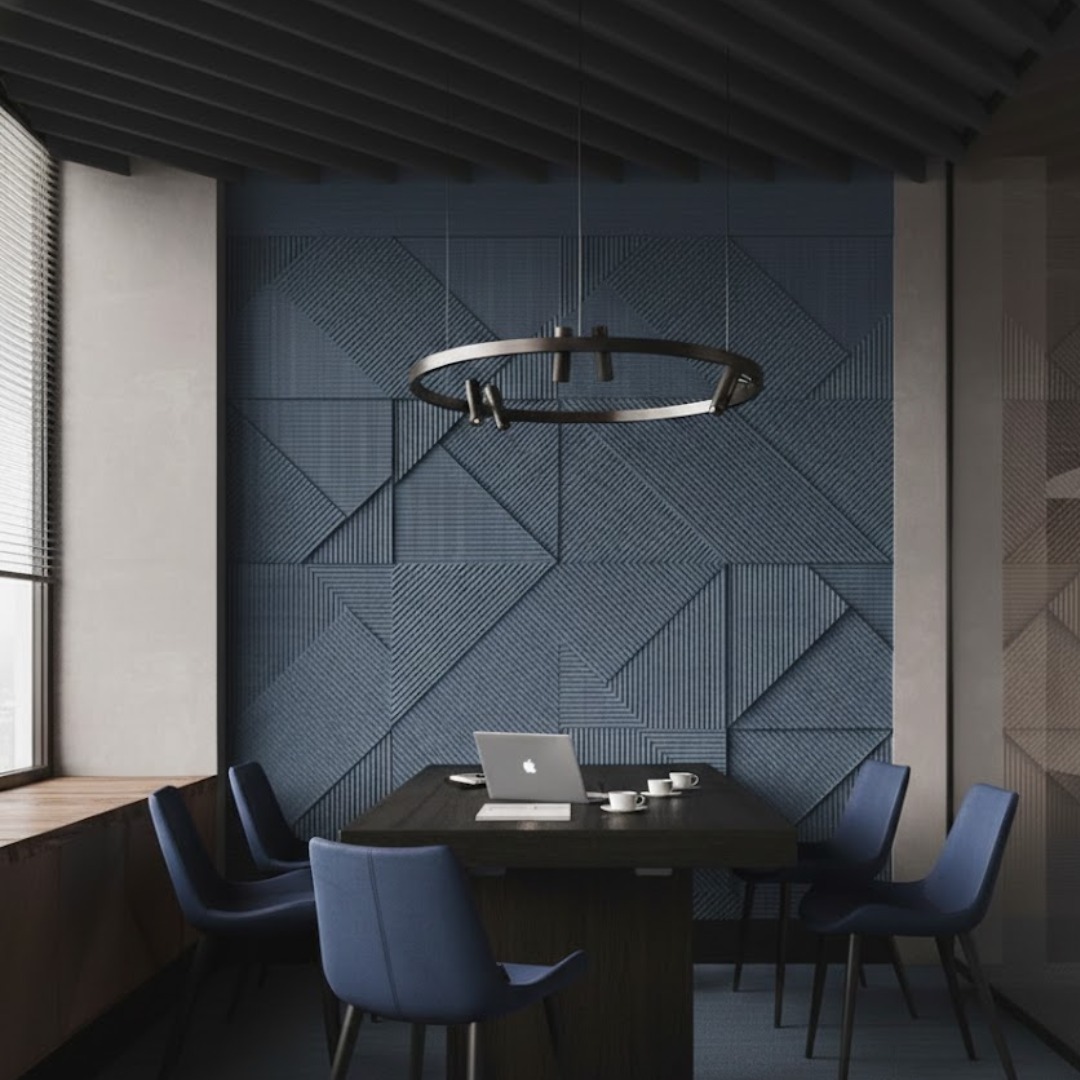
When buying PET acoustic panels in India, check five things: tested NRC with its mounting, thickness and sheet weight, a GreenPro certificate naming the product, where the panels are made, and the finishes offered. GAIA by Sanson Floorings makes its PET panels near Hyderabad, Telangana.
PET acoustic panels have moved from recording studios into ordinary offices, schools, restaurants and homes across India, and the number of suppliers has grown with them. Many boards look identical in a sample box: a felt-like sheet, a colour card and a claim that it "absorbs up to 90 per cent of sound". The differences that matter sit underneath, in how the sound absorption was measured, how dense the board is, whether its green credentials can be checked, and whether the supplier can support a project once the order is placed. The checklist below is the one our own team would use if we were buying.
PET acoustic panels at a glance
- Material: recycled polyester fibre, bonded with heat rather than chemical binders.
- Sheet size: GAIA's standard sheet is 1220 × 2440 mm.
- Thickness: 9, 12, 18 and 24 mm.
- Absorption: NRC 0.3 fixed flat to a wall; NRC 0.85–0.9 mounted with an air gap.
- Certification: each thickness holds its own GreenPro certificate, valid until December 2027.
- Made in: Kothur, Ranga Reddy district, near Hyderabad, Telangana.
What are PET acoustic panels made of?
Polyethylene terephthalate fibre, the same polymer family as plastic bottles, formed into a dense, felt-like board. In GAIA PET acoustic panels the fibres are recycled polyester bonded with heat, so the board holds together without chemical binders or glues. The open fibrous structure is what absorbs sound: sound waves enter the board, lose energy as friction among the fibres, and less sound is reflected back into the room. The same structure makes the panels light and easy to cut on site, far more durable than acoustic foam, and resistant to moisture, insects and mould, which matters in humid coastal cities and during the monsoon.
How do you compare sound absorption between suppliers?
Ask for the NRC, the test method and the mounting it was measured on. NRC, the noise reduction coefficient, runs from 0 (reflects everything) to 1 (absorbs everything). It is measured in a reverberation room under ASTM C423 or ISO 354, and the result depends heavily on how the sample was mounted. The same GAIA board rates NRC 0.3 glued flat to masonry and NRC 0.85–0.9 when it is mounted with an air gap behind it. A supplier that quotes only the higher figure, with no mounting stated, is comparing a different installation from the one most projects will build. European suppliers often add an absorption class from A to E under ISO 11654; ask for that too if your consultant works to it. Our explainer on what NRC means covers how to read the numbers.
Which thickness and sheet weight should you ask for?
The thickness that suits the room, and the sheet weight that proves the board is dense enough. GAIA PET panels are made in 9, 12, 18 and 24 mm thicknesses. A 9 mm GAIA sheet weighs 1,650 g/m² and a 12 mm sheet 2,250 g/m², and other weights and sheet lengths can be produced to order. Two 12 mm boards from different suppliers can perform differently if one is much lighter, so compare grams per square metre, not thickness alone. Thicker boards absorb more of the lower speech frequencies, which is why studios, auditoriums and home theatres tend to specify 18 or 24 mm, while 9 and 12 mm suit offices, classrooms and feature walls. The trade-offs between sizes are set out in 9, 12, 18 or 24 mm panels.
How do you check a green claim?
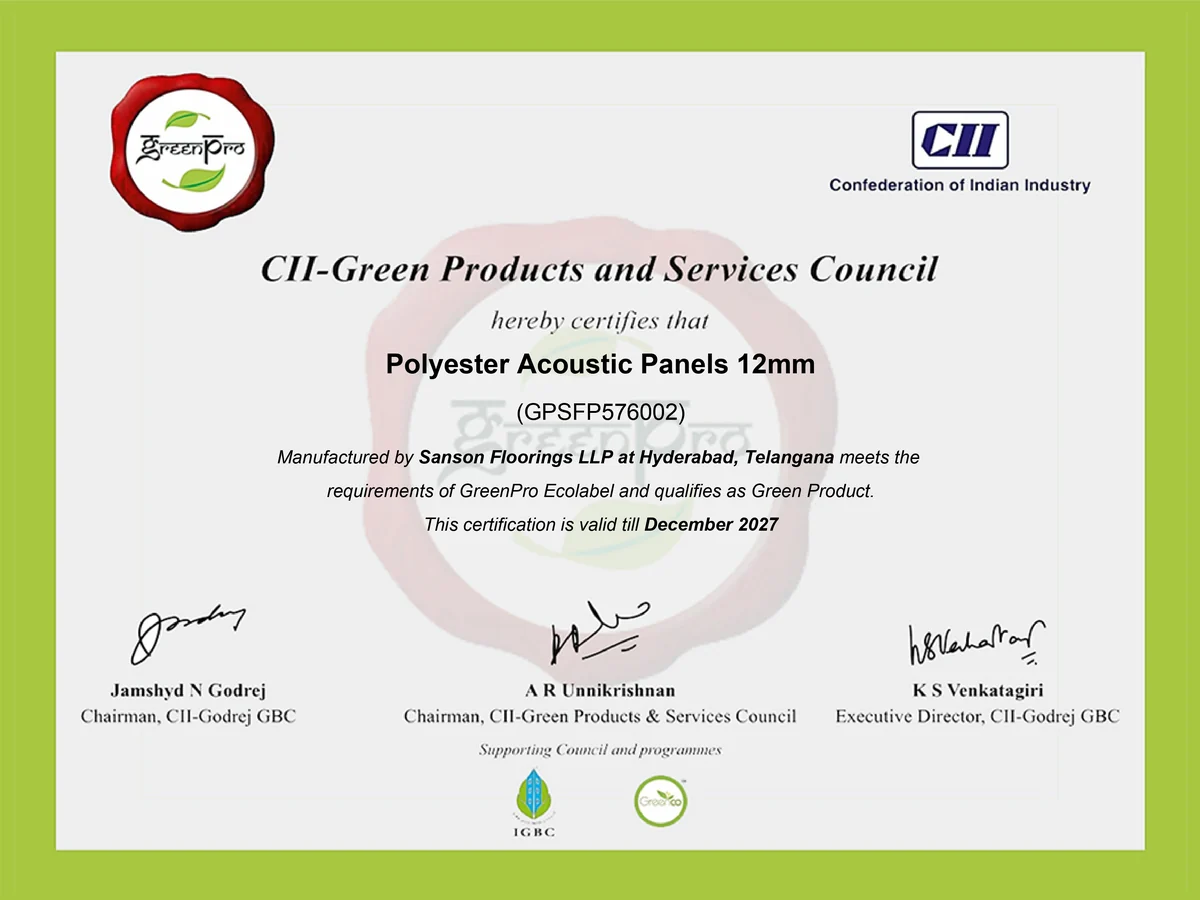
Ask for the certificate, then read it. GreenPro is India's Type 1 ecolabel for building and interior products, run by CII's Green Business Centre and accredited by the Global Ecolabelling Network. A genuine certificate names the product, its thickness or type, the manufacturer, the plant and an expiry date. If any of those is missing, or the product named is not the one being quoted, the claim does not cover your order.
GAIA holds a separate GreenPro certificate for each panel thickness, all issued to Sanson Floorings LLP for its Hyderabad, Telangana plant and valid until December 2027:
- Polyester Acoustic Panels 9 mm: GPSFP576001
- Polyester Acoustic Panels 12 mm: GPSFP576002
- Polyester Acoustic Panels 18 mm: GPSFP576003
- Polyester Acoustic Panels 24 mm: GPSFP576004
What the label assesses is explained in our GreenPro explainer.
Does it matter where the panels are made?
Yes, for lead times, transport and support. Panels made in India avoid import lead times and duties, and a supplier with its own plant controls density, colour consistency between batches and custom sizes. GAIA PET acoustic panels are made at GAIA's plant in Kodicherla village, Kothur mandal, Ranga Reddy district, near Hyderabad. For a multi-floor project it is worth asking whether every sheet will come from the same production run, because colour can shift slightly between batches from any maker.
Which finishes and formats should a supplier offer?
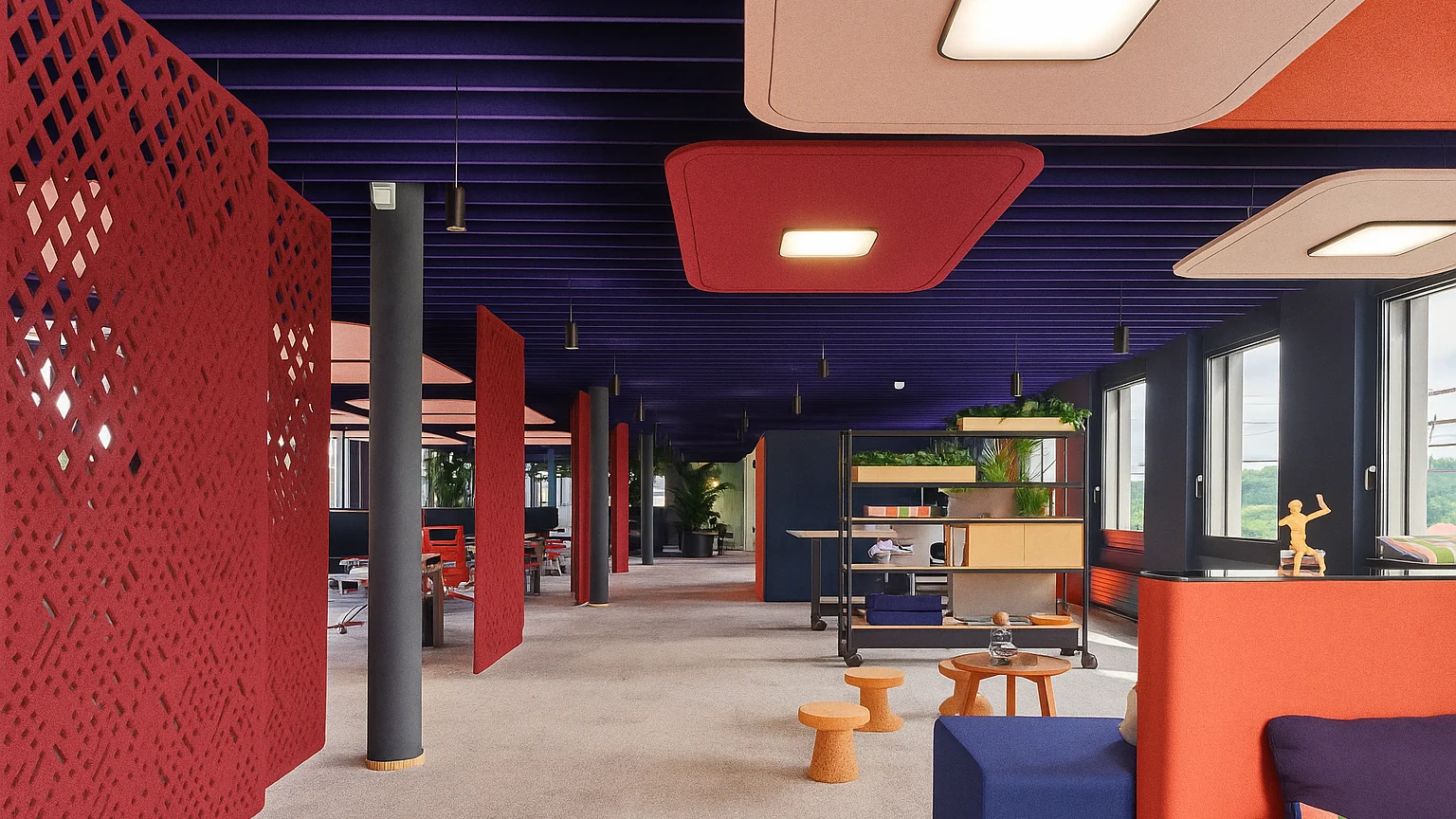
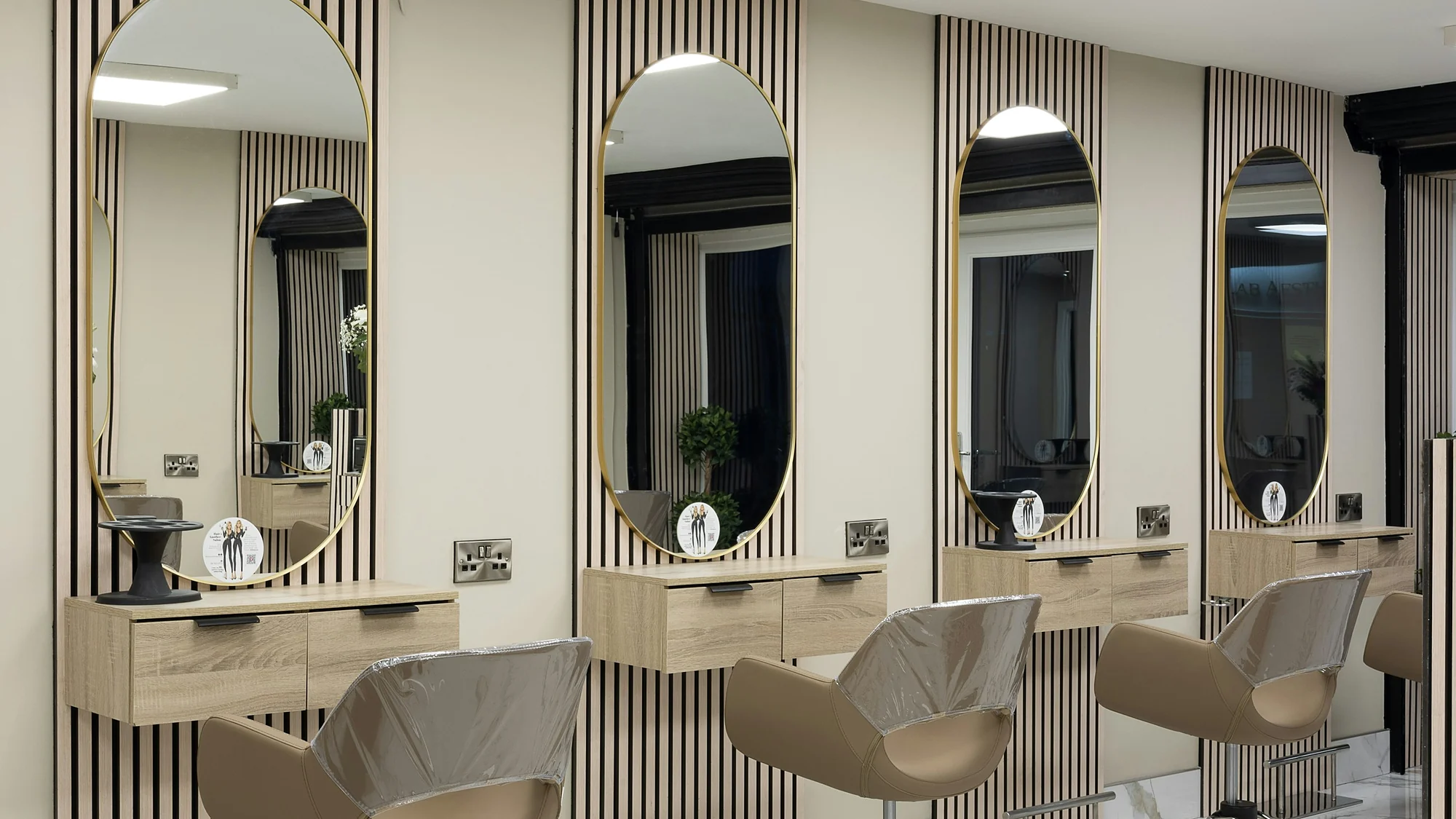
Enough to treat walls and ceilings without changing product. GAIA PET panels come in plain colours, V-groove carved patterns, heat-formed fluted waves, perforated designs and printed artwork, so a meeting room wall can carry a logo and a restaurant wall an illustration while still absorbing sound. For ceilings, GAIA makes baffles and clouds with integrated suspension fittings, hung vertically or horizontally, and an open-cell ceiling for spaces that need a grid look. Being able to source the walls, ceiling and screens from one maker keeps colours matched across a project. The full range is shown under GAIA acoustic panels.
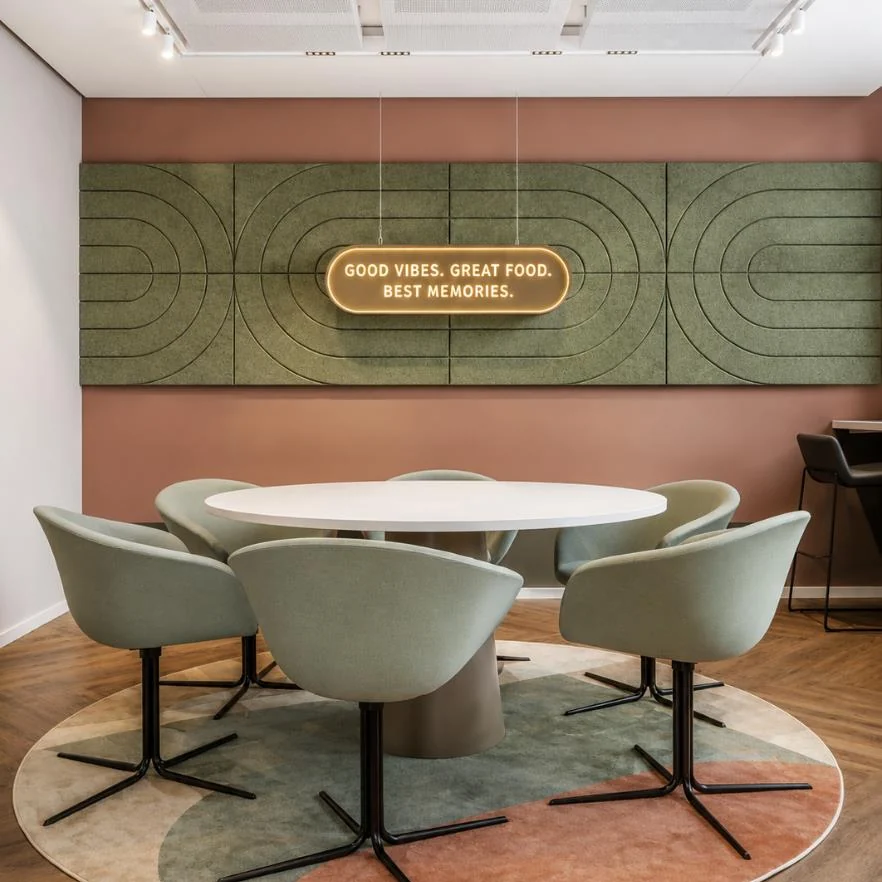


Carved, printed and sculpted: GAIA PET panels absorb sound in whatever finish the design needs.
What about fire safety?
Ask for the fire test report and the standard it was tested to, and check it with the project's fire consultant. Fire requirements depend on the building type, the location of the panels and the local authority, and India's National Building Code sets the framework most projects follow. A supplier should be able to name the test, the laboratory and the product tested, in the same way it names the product on a green certificate. Our team will confirm which documents cover the panels on your specification.
PET panel buying checklist
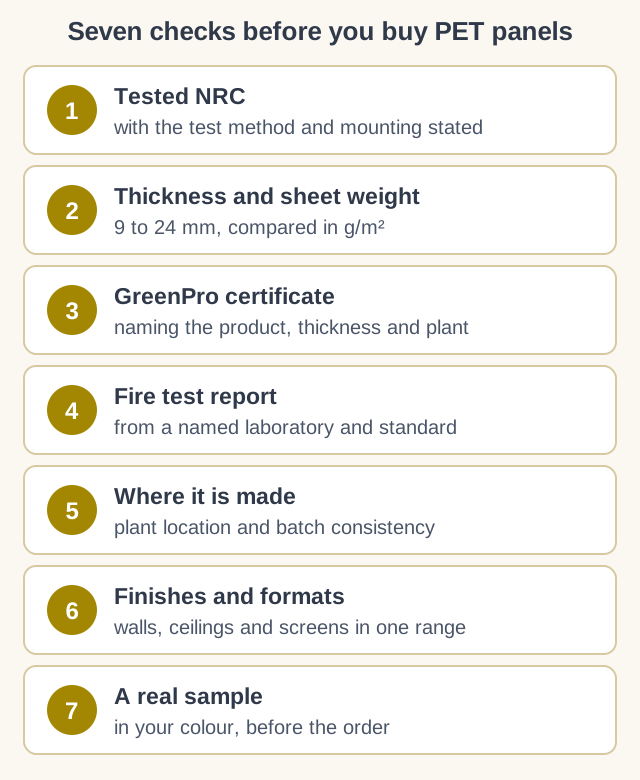
- NRC stated with the test method and the mounting used.
- Thickness and sheet weight in g/m², for the exact product quoted.
- A current GreenPro certificate naming the product, thickness and plant.
- Fire test documentation from a named laboratory.
- Where the panels are made, and batch consistency for large orders.
- Finishes for walls and ceilings from the same range.
- A physical sample in the chosen colour before the order.
What to send us
- the room type, size and ceiling height;
- drawings or photographs of the walls and ceiling;
- the finish and colours you have in mind;
- any acoustic, green or fire requirements in your specification.
Our team will recommend the thickness, mounting and quantity, and send samples and the certificates that cover your order.
PET acoustic panel questions
Are PET acoustic panels better than foam?
For most interiors, yes. PET panels are denser, hold their shape, can be printed or carved, and GAIA's are GreenPro certified. Foam suits small studios on a tight budget. The full comparison is in our article on PET panels and acoustic foam.
What size are PET acoustic panels?
GAIA PET acoustic panels come as 1220 × 2440 mm sheets in 9, 12, 18 and 24 mm thicknesses. They can be cut on site into tiles, strips or shapes, and other sheet weights and lengths can be made to order.
Do PET acoustic panels soundproof a room?
No. They absorb sound inside a room, cutting echo and noise build-up, but they do not stop sound travelling through walls. Blocking sound between rooms needs mass and airtight construction.
How long do PET acoustic panels last?
Indoors and out of direct sun, many years. The board does not crumble like foam, and surface dust can be vacuumed off with a soft brush.
Certified, tested, made in India
Specify PET acoustic panels
Tell GAIA by Sanson Floorings about your room and your specification, and we will recommend the panels, send samples and share the certificates that cover them.