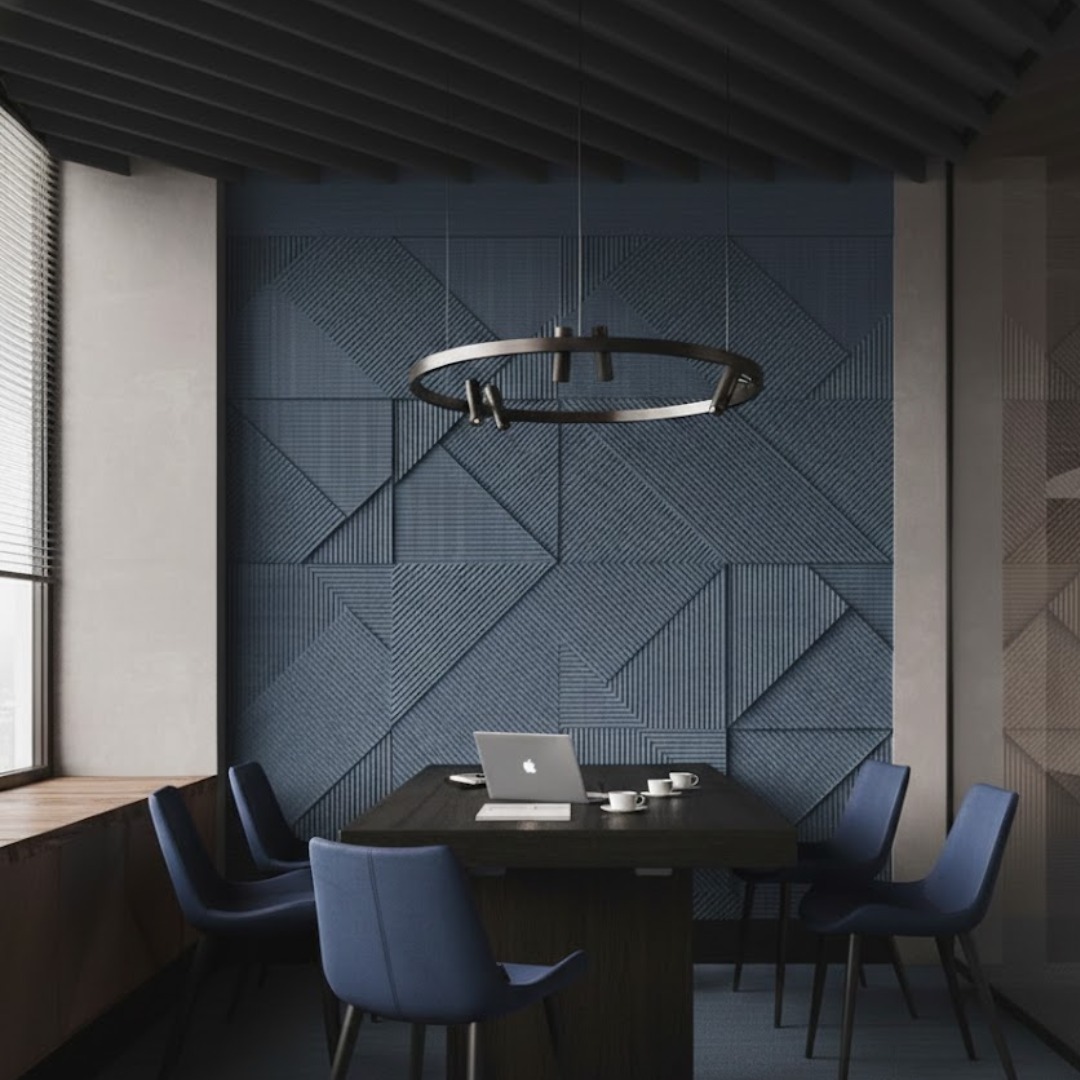
Acoustic wall panels are porous boards that soak up sound instead of reflecting it, cutting echo and noise build-up. Choose them by the room's use, tested absorption, thickness and mounting. GAIA by Sanson Floorings makes PET panels from 9 to 24 mm that reach NRC 0.85–0.9 on an air gap.
Most modern rooms are built from materials that reflect sound: glass, concrete, plaster, stone and tile. They look clean and last for years, and they make rooms echo. Acoustic wall panels are the simplest way to put absorption back into a room without changing its shape, and they have moved from studios and auditoriums into offices, restaurants, schools and living rooms. This page covers what they are, the types available, how to choose and where to put them, and links to our detailed articles on each step.
Acoustic wall panels at a glance
- What they do: absorb sound inside a room, reducing echo and noise build-up.
- What they do not do: stop sound reaching the room next door.
- What decides performance: material, thickness and mounting.
- Where they go: wherever voices strike first, spread around the room.
- How they look: plain, grooved or printed, as quiet or as bold as the room needs.
What are acoustic wall panels?
Panels made from a porous material that lets sound in and turns part of its energy into a tiny amount of heat. Each time a sound wave strikes the panel, less of it bounces back into the room, so speech fades faster and noise does not pile up. That makes a room easier to talk in and less tiring to spend time in. Panels are not soundproofing: blocking sound between rooms needs mass and airtight construction, as soundproofing compared with absorption explains.
Which types of acoustic wall panels are there?
- PET felt panels: rigid boards of polyester fibre, cut to shape and fixed flat or on a gap. Durable, light and available in many colours.
- Grooved and patterned panels: PET boards with carved grooves or cut patterns that add relief and texture.
- Printed panels: PET boards carrying artwork, murals or branding on the face.
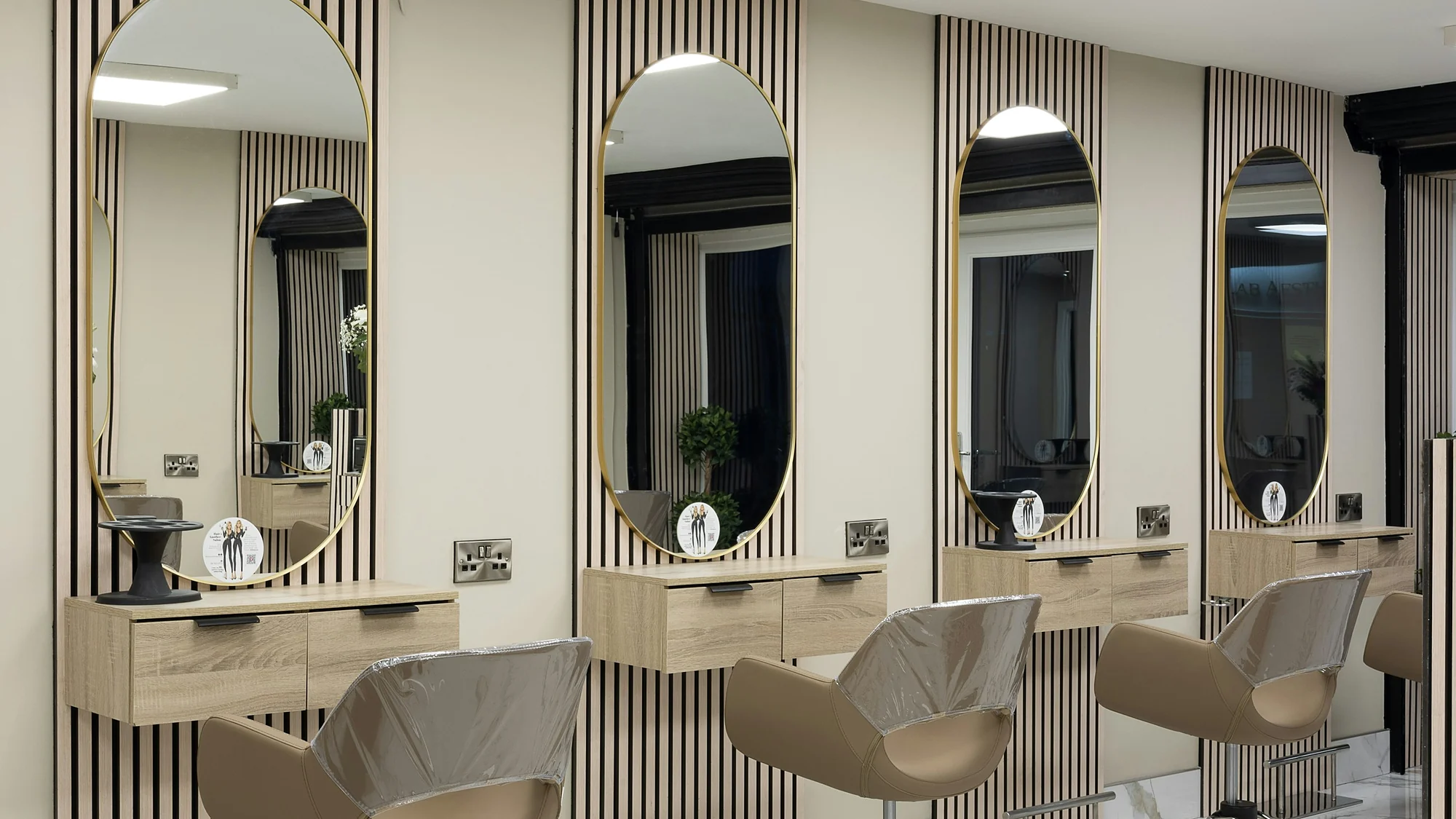
- Slatted timber panels: timber or veneer slats over an absorbent backing, popular in homes and hospitality.
- Fabric-wrapped panels: a fibrous core wrapped in acoustic fabric, common in auditoriums and studios.
- Acoustic foam: soft, lightweight and inexpensive, mostly used in studios and hidden areas; see how it compares in panels versus foam.
What goes into a GAIA PET panel?
Recycled polyester fibre, heat-bonded into a rigid board without chemical binders. Our plant in Kothur, Ranga Reddy district, near Hyderabad, produces them in four thicknesses, 9, 12, 18 and 24 mm, on 1220 × 2440 mm sheets; a 12 mm sheet weighs 2,250 g/m². Each thickness holds its own GreenPro certificate, numbered GPSFP576001 to GPSFP576004 for 9 to 24 mm and valid until December 2027. Finishes run from solid colours to carved grooves and prints of patterns or custom artwork; printed panel feature walls explains artwork, fixing and lighting. Browse the full GAIA acoustic panel range.
How well do acoustic panels absorb sound?
It depends on the panel and especially on how it is mounted. Absorption is measured in a reverberation room under ASTM C423 or ISO 354, and summarised as a single number: NRC in the Indian and American market, or an absorption class from A (best) to E under ISO 11654 in Europe. Glued flat, a GAIA PET panel rates NRC 0.3; set forward on a cavity, the same board rates NRC 0.85–0.90. When comparing products, always compare figures tested in the same mounting you plan to use. Our explainer on NRC shows how to read a test report.
Which thickness should you choose?
The thicker the board and the deeper the space behind it, the lower the frequencies it can absorb. Thin panels mainly tame high, sharp sounds such as clatter and sibilance; thicker panels and cavities reach further into the low, booming range of voices in a full room. As a rough guide, thin panels suit decorative treatment and small rooms, while thicker panels on a gap suit meeting rooms, restaurants and any room where speech must stay clear. The air gap article explains why the cavity matters so much, and 9, 12, 18 or 24 mm panels compares the four GAIA thicknesses room by room.
Where should acoustic panels go on a wall?
Where sound strikes first and most often. In practice:
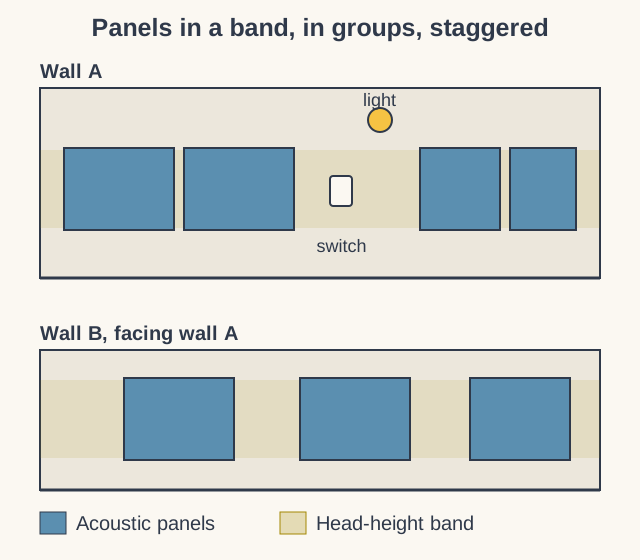
- Around head height. A band covering seated and standing head height catches direct speech.
- On facing walls. Treat both of any pair of parallel hard walls, staggering the panels so reflections cannot bounce cleanly between them.
- In groups, not one block. Several groups spread around the room work better than the same area concentrated on one wall.
- Opposite glass. Glass cannot be treated, so the wall facing it needs extra absorption.
- With the ceiling. In tall rooms, part of the area belongs overhead as clouds or baffles.
To work out the area your room needs, see how many acoustic panels you need.


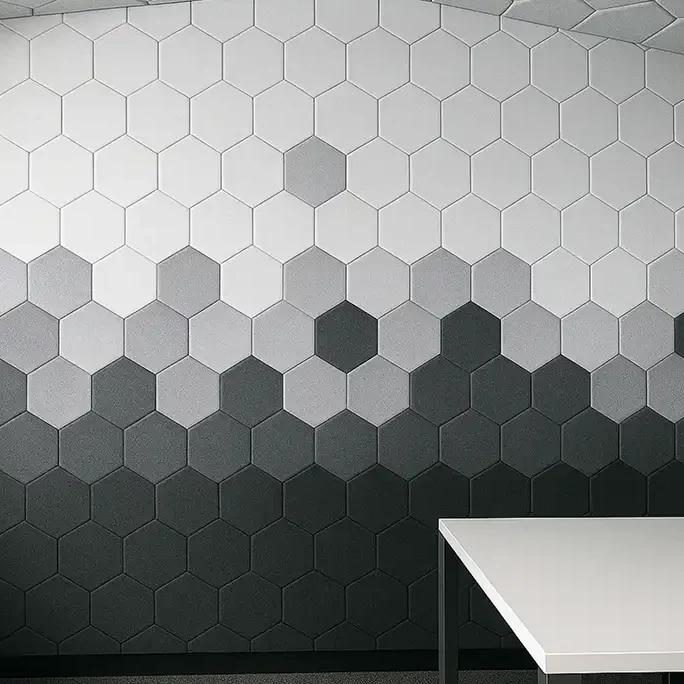
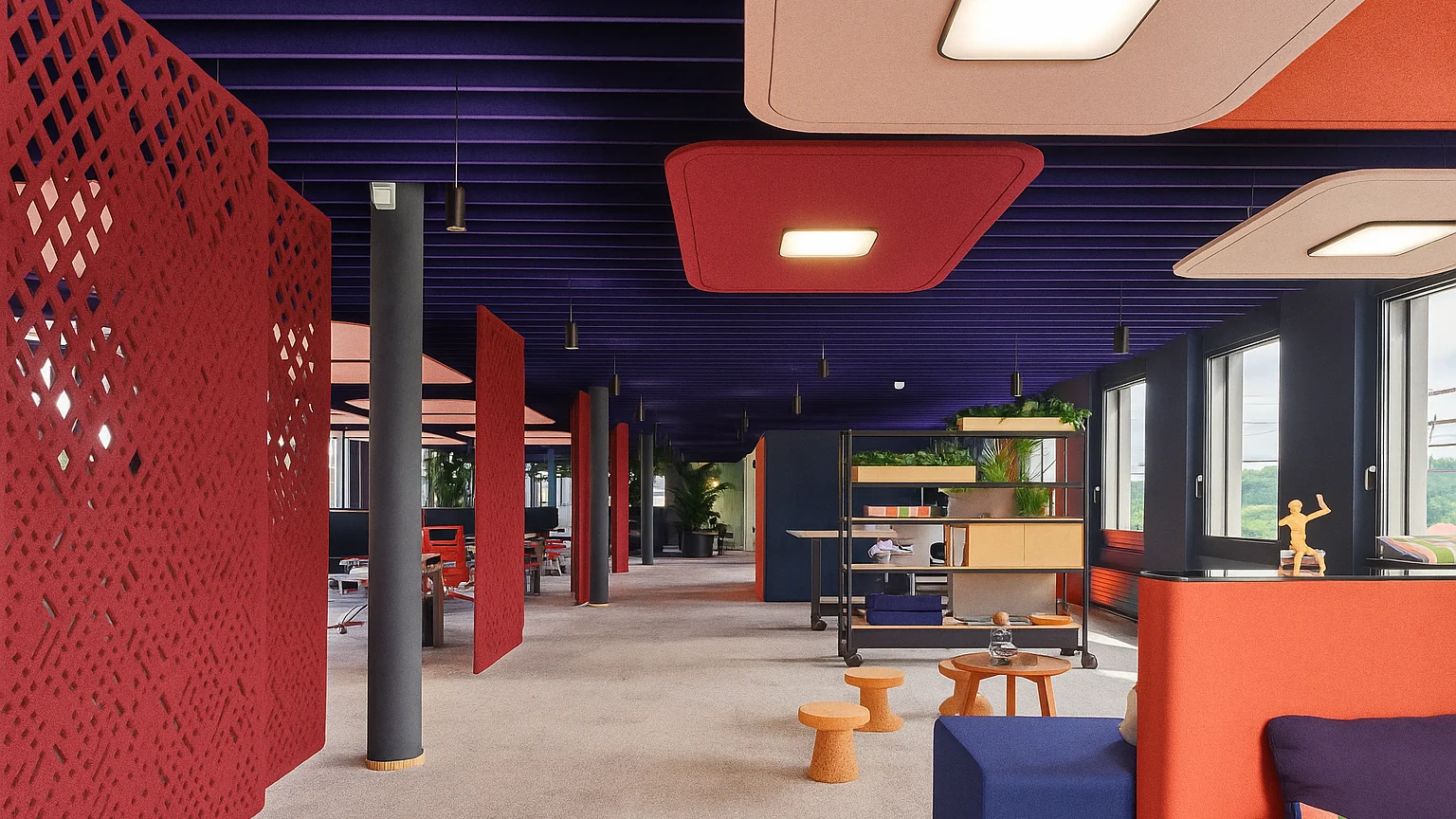
Carved, printed and shaped: GAIA PET panels can be the quiet background or the feature of a wall.
How are acoustic wall panels installed?
Either flat against the wall with adhesive or mechanical fixings, or on battens, clips or a frame that leaves an air gap behind. Direct fixing is quicker and slimmer; an air gap absorbs far more. Either way, switches, sockets, lights and vents must be planned on the wall elevation before any panel is cut. Our step-by-step article on installing acoustic panels covers both methods.
Which rooms benefit most?
- Offices and meeting rooms: clearer calls and less distraction; see office acoustics.
- Restaurants and cafés: diners can talk without raising their voices; see restaurant acoustics.
- Classrooms and halls: speech stays intelligible at the back of the room.
- Homes: living rooms, home offices and bedrooms; see acoustic panels for home.
Which colours and finishes work best?
The ones that suit the room, because performance comes from the board, not its colour. Deep colours make a panelled wall recede and frame a screen or artwork; pale colours keep a small room bright; a single strong accent turns a necessary acoustic wall into a feature. Grooved panels add relief that catches light along a corridor or behind a reception desk, and printed panels let the wall carry a logo, a mural or a pattern. In rooms used for video calls, choose calm, mid-tone finishes behind people's heads rather than busy patterns, which can distract on camera.
Are PET acoustic panels sustainable?
They can be a strong choice. PET panels reuse polyester that would otherwise be waste, and the best are made without chemical binders, which matters for indoor air. GAIA PET panels carry GreenPro certification, an Indian ecolabel for building products; our explainer on GreenPro certification covers what it assesses, and what to check when buying PET panels shows how to read a certificate. Long life matters too: a durable panel that stays on the wall for many years has a smaller footprint than one replaced after a few.
What to send us
- drawings or dimensions of each wall, showing openings and fittings;
- the room's use and its current finishes;
- the look you want: colours, textures or artwork;
- photographs of the space.
Our team will recommend the panel, thickness and mounting, and lay out the panels on your elevations.
Acoustic wall panel questions
Do acoustic panels have to cover the whole wall?
No. Most rooms need treatment on part of several walls rather than all of one. Spreading panels in groups is more effective than covering a single wall completely.
How do you clean PET acoustic panels?
Dust them with a soft brush or a vacuum fitted with a brush attachment. Keep water and cleaning sprays off the face unless the supplier confirms they are safe.
Can acoustic panels go in kitchens, bathrooms or outdoors?
Keep standard acoustic panels to dry, indoor rooms. Steam, splashes, grease and rain all affect porous materials, so wet areas and covered outdoor spaces need products and fixings specified for those conditions. Ask our team before planning panels anywhere damp.
What thickness of acoustic panel is best for walls?
For offices, classrooms and feature walls, 9 or 12 mm usually does the job, ideally on an air gap. For home theatres, studios and loud halls, 18 or 24 mm boards control low sound better.
Quieter walls, any style
Choose acoustic panels for your walls
Send GAIA by Sanson Floorings your wall measurements and photographs, and we will recommend the panel, thickness, finish and layout for your room.