How long carpet tiles last depends on footfall, yarn, pile density and cleaning, not a fixed number of years. Nylon on a dense construction lasts longest in heavy traffic, and worn tiles can be replaced singly, so a floor from GAIA by Sanson Floorings outlasts its busiest routes.
Ask how long a carpet tile floor will last and the honest answer is: it depends on where it goes and how it is looked after. The same tile can look fresh for years in a meeting room and tired within months at the foot of a busy staircase. What wears a floor out is predictable, though, and so are the decisions that slow it down. This article explains what shortens and extends the life of carpet tiles, how to spot when they need attention, and why the modular format changes the question altogether.
Carpet tile lifespan at a glance
- Traffic: the single biggest factor; entrances, corridors and lift lobbies wear soonest.
- Yarn: nylon recovers from crushing best; polypropylene resists stains and moisture at lower cost.
- Construction: a heavier pile on a finer gauge holds its look for longer.
- Grit: walked-in dirt cuts fibres, so entrance matting and vacuuming matter.
- Replacement: single worn tiles can be swapped, so the floor need not be replaced all at once.
What decides how long carpet tiles last?
Traffic, construction and care, in roughly that order. Every footstep crushes the pile a little and grinds in a little grit. Where thousands of steps a day follow the same route, the pile flattens, the colour dulls and a visible track forms. A carpet tile resists that through its yarn and construction: how resilient the fibre is, how much yarn is packed into each square metre and how tightly the tufts are set. GAIA's collections show the range. GAIA Gridwork and ArchiBrown carry an 18 oz pile at 1/12 gauge, GAIA Nevada 575 g/m² at 1/12 gauge, and Trends and Rhythm 500 g/m² at 1/10 gauge. How to read those figures is explained in how to read a carpet tile specification.
Do nylon carpet tiles last longer than polypropylene?
In heavy traffic, yes. Nylon springs back after being crushed, so traffic lanes stay less visible for longer. Polypropylene, sold as olefin, does not absorb water and shrugs off many stains, which keeps it looking clean in places with spills, but it flattens more readily under constant footfall. The US National Institutes of Health's carpet fundamentals bulletin notes that polypropylene has good stain resistance and texture retention but is not as strong or resilient as nylon. GAIA makes tiles and planks in both yarns; the comparison is in nylon vs polypropylene carpet tiles.
How does maintenance affect carpet tile life?
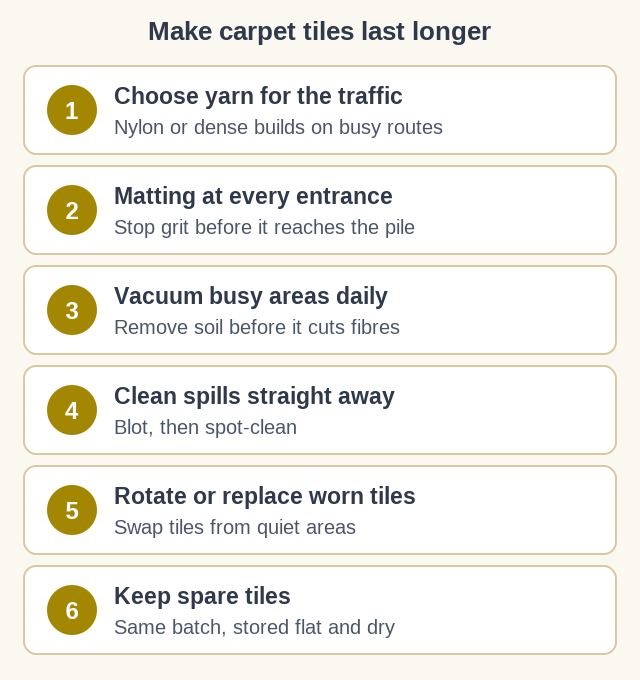
More than most people expect. Dry soil is abrasive: grit carried in on shoes works down into the pile and cuts the fibres every time someone walks over it. Removing it before it settles is the most effective thing a building can do. That means matting at every entrance, vacuuming the busiest areas daily, treating spills straight away and scheduling deeper cleaning before the floor looks dirty rather than after. The Carpet and Rug Institute's commercial cleaning and maintenance guidance sets out this kind of planned routine. In Indian cities, dust storms and the monsoon both bring in extra soil, so increase vacuuming in those months. A full routine is in how to clean carpet tiles.



Lobbies, cafés and breakout areas: the places where carpet works hardest.
Why carpet tiles can outlast a broadloom carpet
Because a worn area can be replaced on its own. When a wall-to-wall carpet wears out in front of the lifts, the whole room usually has to be recarpeted. With tiles, the worn or stained ones are lifted and replaced, and the rest of the floor stays. The NIH bulletin makes the same point: a carpet tile installation may have a longer life if worn areas are replaced, and spare tiles should be bought and stored for that purpose. Some facilities also rotate tiles between busy and quiet areas to even out wear. For that to work, buy spares from the same production batch at the time of the main order, so the colour matches. More on the two formats is in carpet tiles vs broadloom, and the steps for a single tile are in how to replace a damaged carpet tile.
When should carpet tiles be replaced?
When cleaning no longer restores them. Signs include traffic lanes that stay flat after vacuuming, fraying or exposed backing at the edges, permanent stains, and tiles that lift or curl. If the problem is confined to routes and entrances, replace those tiles. If it covers most of the floor, plan a full replacement, and use the opportunity to upgrade the construction or yarn in the busiest zones. Choosing a heavier construction there from the start is usually cheaper than replacing it early.
Carpet tile life checklist
- Map the heaviest traffic routes before choosing the product.
- Use nylon or a dense construction on those routes.
- Install entrance matting long enough to catch grit.
- Set a daily vacuuming routine for busy areas.
- Store spare tiles from the same batch.
See the full range under GAIA carpet tiles.
What to send us
- the floor plan with the busiest routes marked;
- how many people use the space each day;
- how the floor will be cleaned;
- whether you are replacing an existing floor, and why.
Our team will recommend the yarn and construction for each zone.
Carpet tile lifespan questions
Do carpet tiles last longer than carpet?
The floor as a whole often does, because worn tiles can be replaced singly instead of recarpeting the room. The fibre itself wears at a similar rate to broadloom of the same construction.
How many spare carpet tiles should I keep?
Keep a small stock from the same batch for replacements. Some facility standards ask for about 5 per cent of the installed area, or at least one box.
Can worn carpet tiles be cleaned back to new?
Cleaning removes soil and many stains, but it cannot restore crushed or cut fibres. Once a traffic lane stays flat after cleaning, replace those tiles.
A floor that keeps its looks
Choose carpet tiles that last
Show GAIA by Sanson Floorings how your space is used, and we will recommend the collection and construction for each zone.