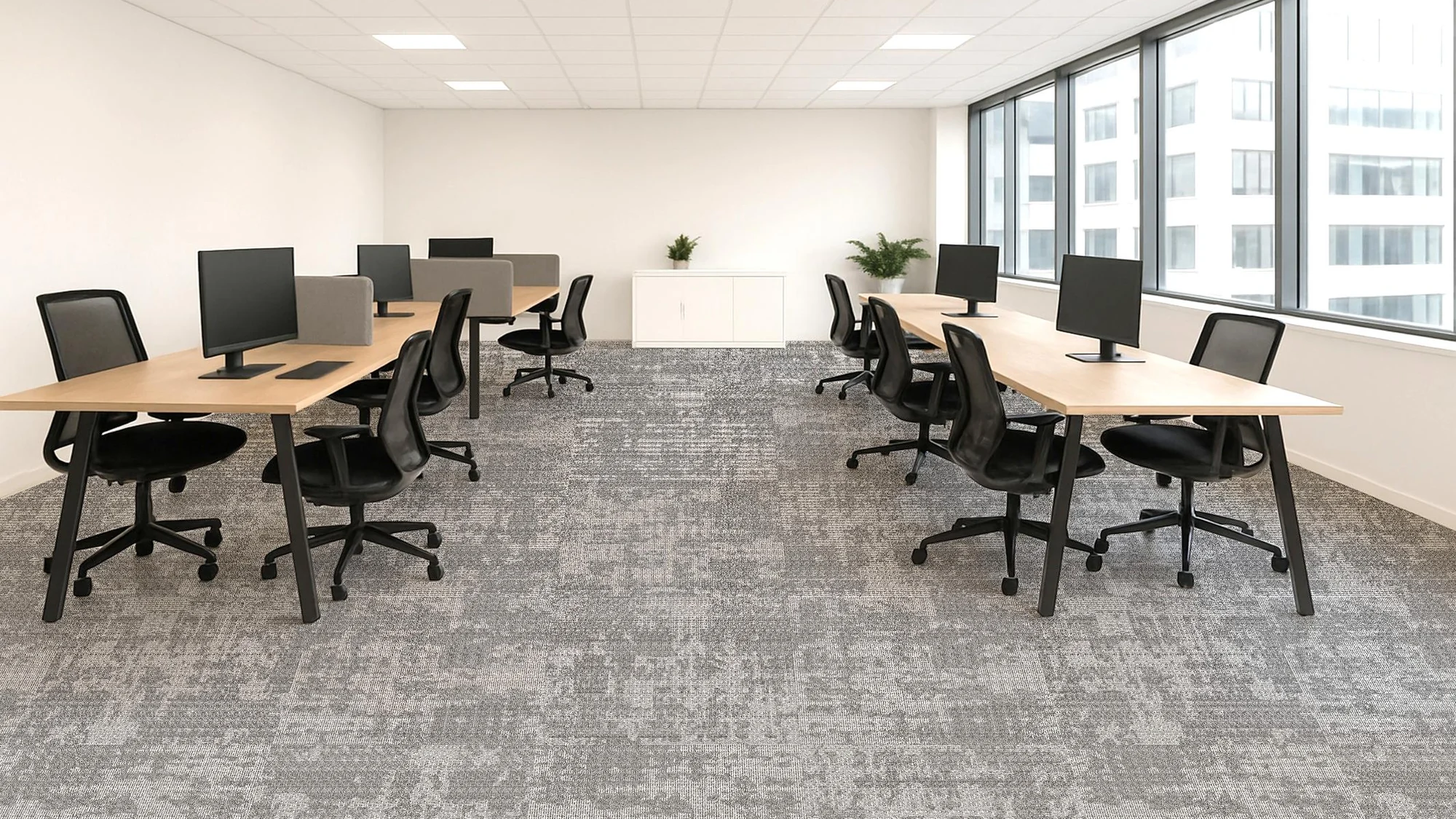
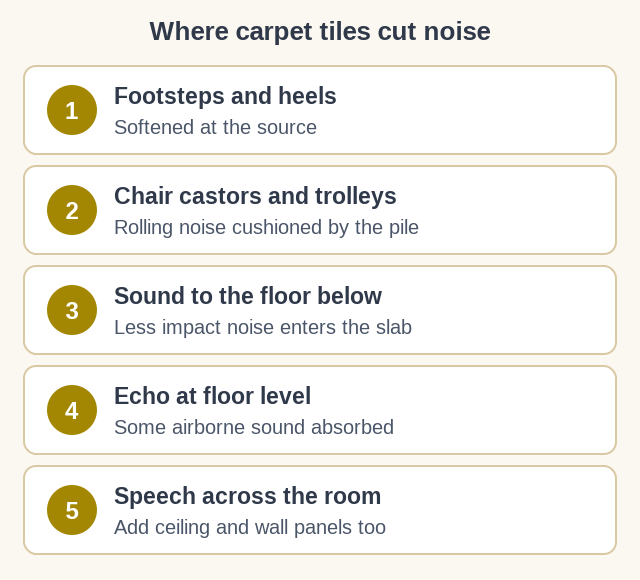
Yes. Carpet tiles reduce noise mainly by softening impact sound at its source: footsteps, heels, chair castors and dropped objects. They also absorb some airborne sound. They do not stop speech travelling across an open office, so pair them with ceiling and wall panels from GAIA by Sanson Floorings.
Hard floors are loud floors. Vitrified tiles, stone and bare concrete reflect sound and turn every footstep, chair scrape and dropped file into noise that carries across a room and down into the floor below. Many Indian offices, schools and hotels are built almost entirely of hard surfaces, and the noise shows up as complaints about concentration, privacy and fatigue. Carpet tiles are often the quickest fix. This article explains which noise they reduce, which they do not, and how to plan them as part of a complete acoustic scheme.
Carpet tiles and noise at a glance
- Impact noise: greatly reduced, because footsteps and castors land on a soft surface.
- Noise to the floor below: reduced, as less impact energy enters the slab.
- Echo in the room: reduced a little, since the floor adds some absorption.
- Speech privacy: needs ceiling, wall and layout measures as well.
- Sound through walls: unaffected; that is a soundproofing problem.
How do carpet tiles reduce noise?
In two ways. They change what happens when something hits the floor. A heel striking vitrified tile makes a sharp click that radiates into the room and travels through the slab; the same heel on a tufted carpet tile is cushioned by the pile, so far less sound is created to begin with. The pile also absorbs some of the airborne sound that reaches the floor, rather than reflecting all of it back. The effect on impact sound is the larger of the two. That is why carpet is often specified on upper floors of offices and hotels, where footfall noise reaching the room below is a common complaint. Impact sound insulation of floors is rated under ISO 717-2, the international standard that turns laboratory measurements into a single number for comparing floor constructions.
Do carpet tiles stop echo in a room?
They help, but rarely on their own. Echo, or reverberation, builds up when sound bounces between hard, parallel surfaces: the floor, the ceiling and the walls. Carpet treats one of those surfaces. In a room with a hard ceiling, glass walls and plastered partitions, the remaining surfaces still reflect plenty of sound, and the room can still feel lively. The ceiling is usually the biggest surface available for absorption, and walls at head height catch speech directly. How much absorption a material adds is described by its noise reduction coefficient, explained in what NRC means. For echo itself, see how to reduce echo in a room.
Are carpet tiles enough for an open-plan office?
No, but they are an essential layer. Open offices suffer most from speech: conversations and phone calls that carry several desks away and break concentration. The international standard for open office acoustics, ISO 22955, treats the space as a whole, combining absorbent ceilings and walls, screens between desks, layout and background sound. Carpet tiles take care of the floor's share: they quieten footfall and chair movement, which are constant in a busy office, and they stop the floor reflecting speech back into the room. Pair them with acoustic ceiling elements and wall panels, as set out in our guides to noise reduction in open-plan offices and office acoustics.


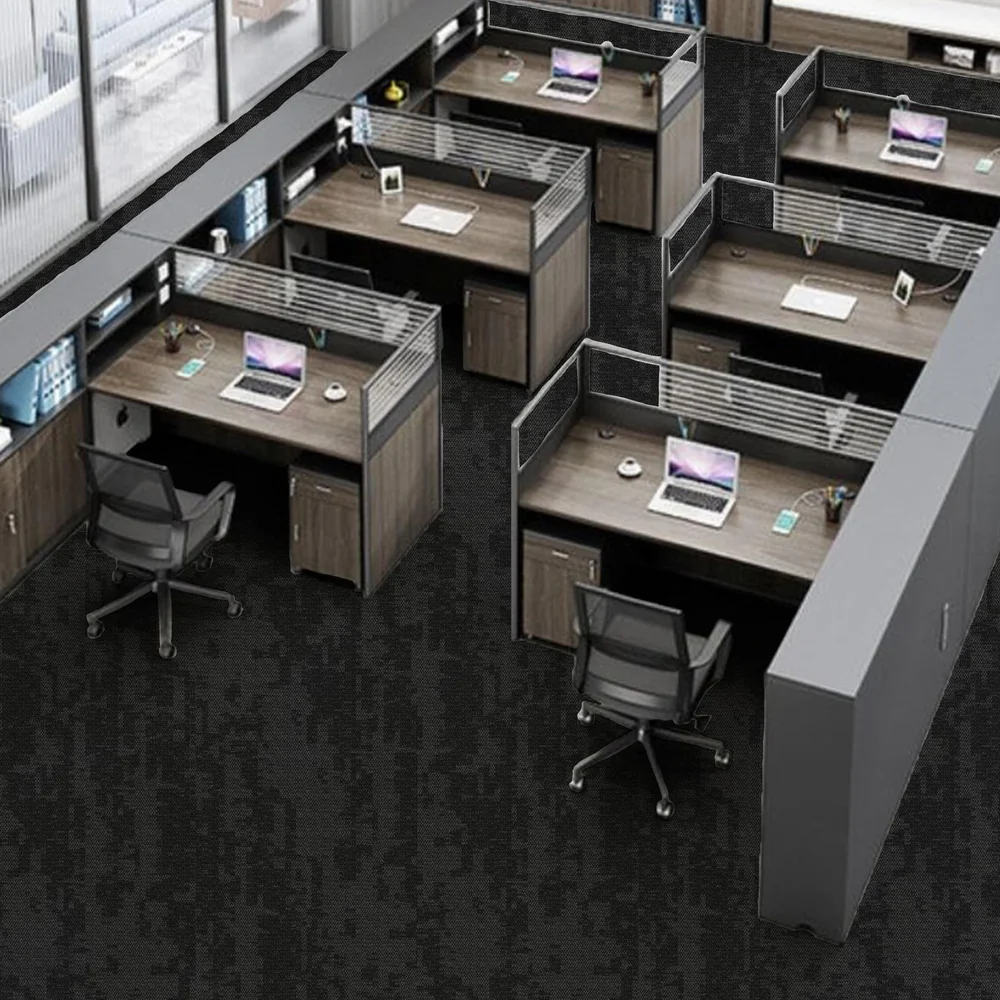
Lounges, meeting booths and workstations: where footfall and chair noise build up during the day.
Do carpet tiles stop noise travelling to the floor below?
They reduce footfall noise reaching the room below, which is often what neighbours below complain about. They do little for airborne sound, such as loud music or voices, passing through a slab, and nothing for sound passing through walls. Blocking sound between rooms is a question of mass, airtightness and construction, a different task from absorbing it inside a room. The distinction is explained in soundproofing vs sound absorption.
Which carpet tile is quietest?
As a rule, a denser, heavier pile cushions impact better, and a cushion-backed tile adds a further soft layer. Construction varies between collections: GAIA's carpet tiles are tufted in olefin or nylon on a bitumen backing, with pile weights from 500 g/m² in collections such as Trends and Rhythm to 575 g/m² in GAIA Nevada and 18 oz per square yard, about 610 g/m², in Gridwork and ArchiBrown. GAIA does not publish acoustic test figures for its carpet tiles, so where a specification sets a measured target, ask for test reports and treat the floor as one part of the design. How backings differ is covered in carpet tile backing explained.
Quieter floor checklist
- List the noise you want to reduce: footsteps, chairs, speech or sound to the floor below.
- Carpet the busiest walking routes and the areas around desks.
- Add ceiling absorption over open-plan areas.
- Treat walls where people meet, talk and phone.
- Use felt pads under furniture that is moved often.
The collections are shown under GAIA carpet tiles.
What to send us
- the floor plan and how each area is used;
- where the noise is worst, and when;
- the current floor, ceiling and wall finishes;
- any acoustic targets in your specification.
Our team will recommend carpet tiles and acoustic panels for each zone.
Carpet tiles and noise questions
Are carpet tiles good for sound absorption?
They absorb some airborne sound at floor level and greatly reduce impact noise. For strong absorption in a room, add acoustic panels on the ceiling and walls.
Are carpet tiles quieter than vinyl flooring?
Generally yes, for footfall and chair noise, because the pile cushions impact. The two floors are compared in carpet tiles vs vinyl flooring.
Do carpet tiles help in classrooms?
Yes. They quieten chair movement and footsteps, which are a large part of classroom noise, and work best with an absorbent ceiling.
A quieter floor to start with
Plan a quieter space
Tell GAIA by Sanson Floorings where noise is a problem, and we will recommend carpet tiles and acoustic panels that work together.